Emerging from a years-long dialogue between Oradea’s cultural visionaries and its community, NOCA marks a bold new chapter in the city’s artistic identity. Housed in a striking glass pavilion beside the historic Black Eagle Palace, the center positions itself as a dynamic hub for contemporary creation, experimentation, and exchange. With a curatorial strategy that bridges local legacies and international perspectives, NOCA aims not only to fill a long-missing gap in the region’s cultural landscape, but to redefine how a contemporary art institution can grow—organically, collaboratively, and with a keen sensitivity to place.
– an interview with Suzana Vasilescu and Cristina Vasilescu
Could you tell us more about how NOCA came into being? Who initiated the idea of founding a contemporary art institution in Oradea, and what were the main motivations behind it?
The NOCA idea came into being after several years of dialogue between the local authorities and the local community. The glass pavilion is part of a larger project that completely revitalized a riverbank area located near the epicenter of Oradea, Unirii Square. Considering the exceptional surroundings and the magnificence of the Black Eagle Palace, neighboring the NOCA pavilion, the idea that took shape was that of a glass structure, a space of transition, admiration, and reflection of the city’s patrimony. Oradea Heritage, a foundation created by the Oradea City Hall, with its focal purpose of preserving the city’s diverse and unique architectural legacy is the one named to propose a concept and to find a purpose for the new pavilion.
Thus, the Oradea Heritage management came up with the idea to create a center that constantly dedicates its efforts to the contemporary local, national, and international art scene. A space of dialogue, exhibitions, performances, happenings dedicated to important Romanian artists but with a strong mentoring sense for new emerging artists. Oradea phenomenal development in the past decade created a welcoming environment for new museums such as the Darvas-La Roche House, the only Art Nouveau museum in Romania, thus the Oradea Heritage management felt that it would represent the perfect timing to start building a new space dedicated to contemporary art that could increase the cultural local offerings. Romania has few cities that have built a good reputation as contemporary art poles – Bucharest, Cluj-Napoca, Timisoara. Oradea has all the features to become such a destination.
The opening of a new contemporary art space in the region feels both ambitious and timely. What kind of gap or need did you see in the local and regional art ecosystem?
Oradea is well-known for its historical architectural styles such as Baroque, Secessionist and Neo-Romanian styles, especially since the city hall renovated approximately 60% of its most iconic buildings. The city attracts around one million tourists annually and is in the proximity to Hungary, Austria, Slovenia and other destinations. The Oradea Heritage Foundation, also the founder of NOCA, administers seven major heritage buildings and organises a diverse range of events, either in connection to these buildings, such as the transformation of Darvas House into an Art Nouveau Museum, or that activate the city more broadly, like three-day festival Oradea FestiFall.
Yet, the foundation realised that the field of contemporary art was missing from the city’s cultural landscape, and that both citizens and visitors would appreciate such an initiative. This recognition led to the materialisation of NOCA. It is also worth nothing that in the 1970s and ‘80s, Oradea was home to Atelier 35, an influential network of art spaces throughout Romania that encouraged experimental artistic practices despite the constraints of the communist regime. So, not long ago, Oradea played a key role in the formation of contemporary art, but after ‘89 it became less active, overshadowed for decades by nearby cities of Cluj and Timisoara. Today, NOCA is clearly emerging as an important pillar in the local and regional art ecosystem.
Could you introduce the founding and curatorial team? What backgrounds do you come from — institutionally, artistically, or academically — and how do these different perspectives shape NOCA’s identity?
The founding and curatorial team is small, yet this has allowed the entire process to unfold with remarkable clarity and efficiency. As mentioned previously, the space was founded by the Oradea City Hall and the Mayor of Oradea, Florin Birta, through the Oradea Heritage Foundation, led by its Director, Alexandru Chira.
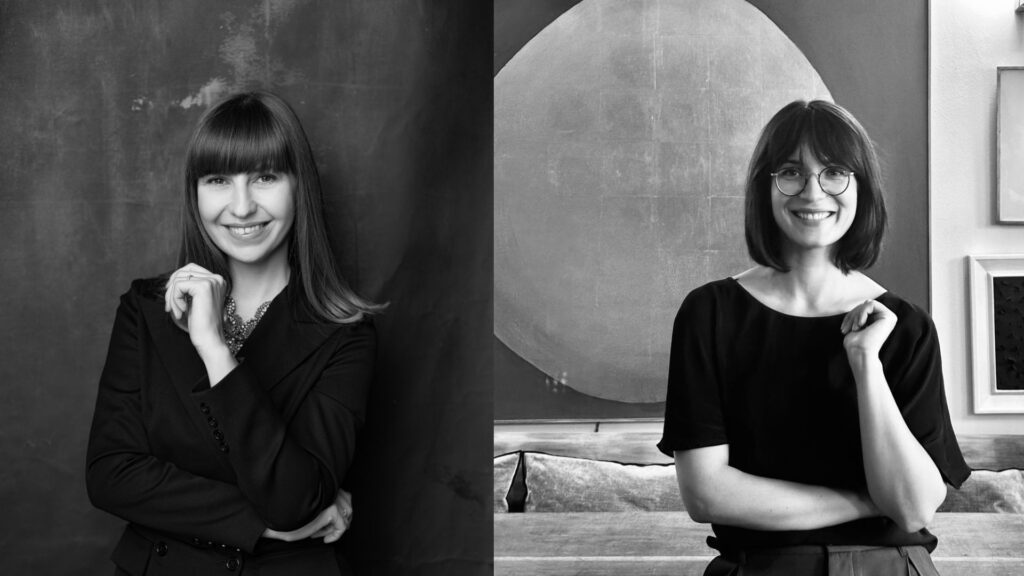
The curatorial team currently consists of NOCA’s Artistic Directors, Suzana Vasilescu and Cristina Vasilescu (not sisters, in case you were wondering), who shaped the institution’s artistic vision from the ground up, defining its program, ethos, and long-term direction.
Suzana Vasilescu is an art historian, gallerist and art advisor whose work has contributed to the development of contemporary art in Romania. She is the founder and director of SUPRAINFINIT Gallery in Bucharest, known for presenting both emerging and established artists, as well as for rediscovering important figures in Romanian art; and Ans Azura platform dedicated to artists in CEE and MENA.
Her institutional involvement includes serving on the Board of the Museum of Recent Art in Bucharest and contributing to its long-term vision. She is also the co-founder of RAD Art Fair, alongside other Romanian gallerists, the first independent art fair in Romania, which has opened new spaces for dialogue between artists, collectors, and institutions.
Through her work with NOCA, Suzana continues to focus on expanding access to contemporary art and on developing sustainable cultural infrastructures in Romania.
Cristina Vasilescu comes from an academic background, having completed a BA in Social and Cultural Studies at Goldsmiths and an MA in Curating Contemporary Art at the Royal College of Art, also in London. Since 2018 she has been the Artistic Director of SUPRAINFINIT Gallery. In 2020 she co-founded Quote—Unquote, a Bucharest platform investigating the mechanisms and effects of (public) speech via artistic practice. Previously, she co-directed clearview project space in North London and worked at the ICA London (2014-2018).
For her, maintaining a balance between exhibition-making and public programming is essential, and this approach naturally shapes the curatorial direction at NOCA, aligning closely with both Suzana’s and Alexandru’s visions. Equally important is establishing a friendly and accessible tone when mediating the exhibitions and projects, ensuring that contemporary art does not appear overly pretentious or hermetically distant from the public.

How does the internal structure work between the founders, curators, and invited collaborators? Is it a collective model, or are curatorial responsibilities more individualized?
The internal working structure is firstly discussed between the two artistic directors and Alexandru Chira, the Director of the Foundation, who is also the main decision-maker regarding funding and budgets. Suzana and I generally have curatorial carte blanche, which is fantastic, but of course we take into consideration the needs of the local scene in Oradea. Our vision combines both meaningful exhibitions and playful, expansive public programming. The plan for 2026 is already sketched, now we need to start adding flesh to the bones! In the longer term, we will also invite collaborators to join specific projects.
Moreover, the public programming will open opportunities for collaboration, helping to broaden the narratives and perspectives of the core artistic directors’ team. We aim to work with and gradually form a solid group of collaborators who become recognisable contributors to NOCA. However, this will not shadow our openness to new creative voices and inputs. Dialogue will always remain key to our planning and organisation.
How important was it for you to build a local team versus involving professionals from other cities or countries?
It’s very important to maintain a good balance. As mentioned in the response to the previous question, one of our aims is to gradually form a solid group of local collaborators who become recognisable contributors to NOCA.
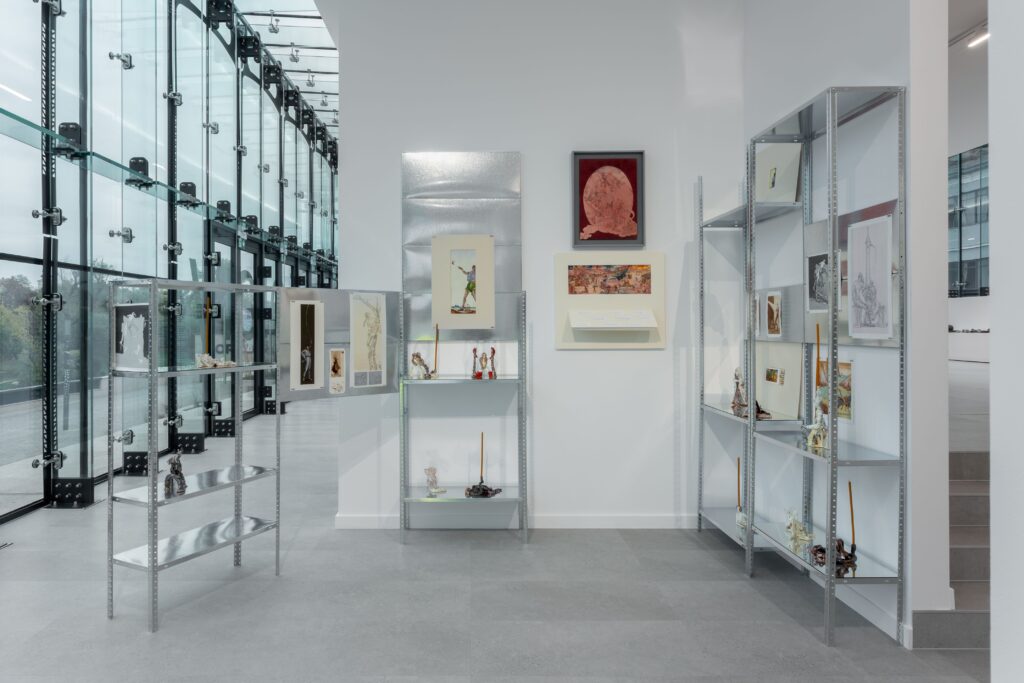
For the first exhibition we installed at NOCA, almost everyone from the Oradea Heritage Foundation team offered to help or get involved. Even high school teenagers joined us, helping to build the shelf installation by Ana Botezatu and Alex Bodea. They were curious, calling their friends to come and see this new, cool space in town. These are precisely the people we hope to collaborate with in developing the centre’s cultural mediation and involving them in the educational program.
Things will happen slowly but surely. We are planting seeds now, following a process similar to permaculture. But Oradea’s residents seem to have both patience and curiosity to embark on this journey with us.
What defines NOCA’s curatorial vision? Are you aiming for thematic, research-driven exhibitions, or more intuitive, artist-centered approaches?
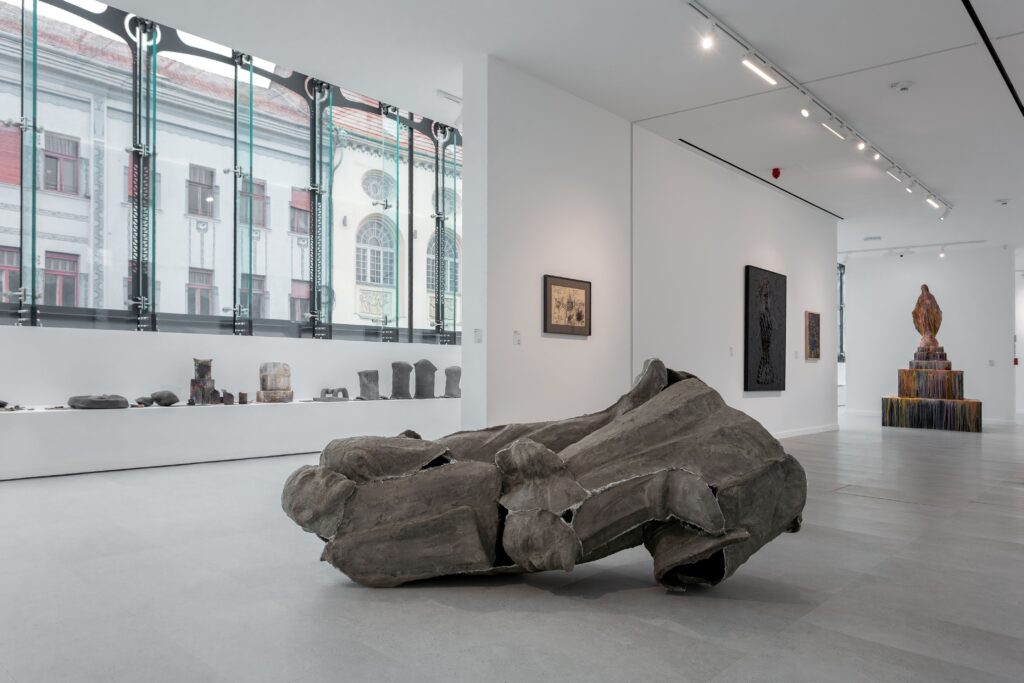
NOCA’s curatorial vision is defined by its urgency, as well as by both research-driven and intuitive approaches. Again, it is essential to harmonise this vision with the site-specific context. Our aim is to create a platform for experimenting with innovative curatorial and artistic premises. We launched the space with a group exhibition featuring local artists (Márta Jakobovits, Vioara Bara, Rudolf Bone), national (Michele Bresssan, Ciprian Mureșan, Ștefan Bertalan, Ion Țuculescu, Ecaterina Vrana) and international or internationally-based artists (Christian Jankowski, Miron Schmückle, Alex Bodea, Ana Botezatu, Apparatus 22), where the concept and the selection of artists developed hand in hand through an organic process.
In general, the program aims to include two to three major exhibitions each year, along with a third dedicated to students from the University of Arts of Oradea and the surrounding region. The program will bring together local and international artists, both emerging and established, as well as rediscovered and new voices, in exhibitions and discursive programs that deepen the close relationship between art, culture and society.
How does the first exhibition (“A Sphinx, Beast & Girl; Unicorn, Chimera and Mixed Body”) reflect this curatorial philosophy?
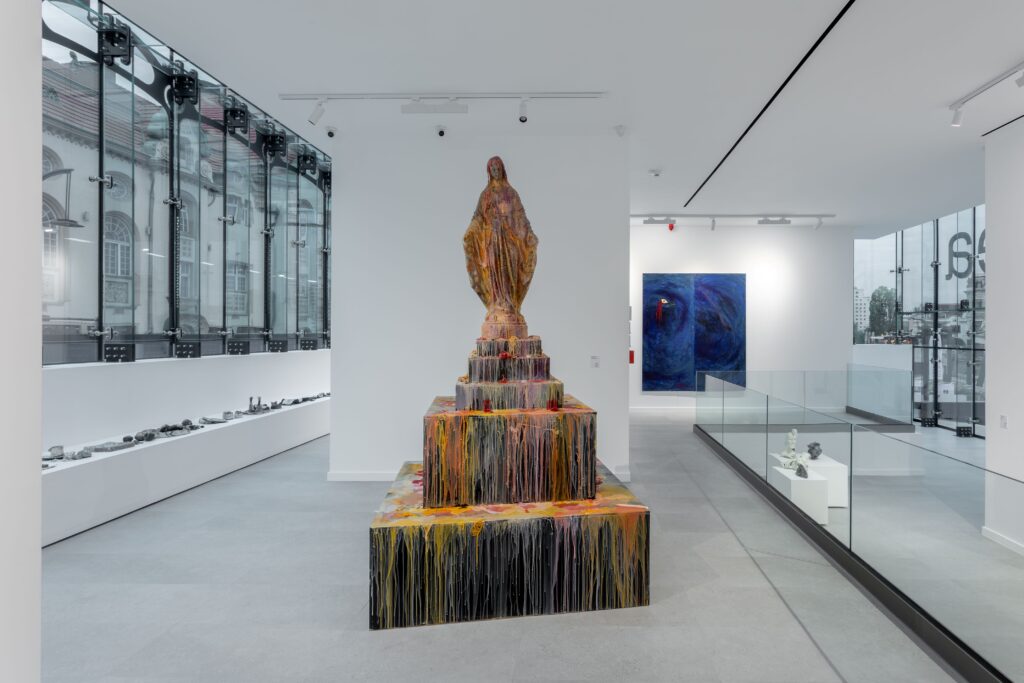
For the first exhibition, it was clear that we wanted to interweave a wide mix of artistic practices with a conceptual line that encapsulates all those artistic voices. In The Troubadour of Knowledge, Michel Serres writes about knowledge as something that is produced through detours, mixing bodies rather than by reference to a single stable centre. It defies conceptual unity. So the monster is not simply a monster; it’s the figure that binds contradictions without resolving them. Knowledge comes from this mixed condition of improbable unions. In this sense, a curatorial methodology that takes Serres seriously cannot be entirely preplanned or overplanned. It has to hold together what we can anticipate and what we cannot. Some things can be designed in advance, for instance the desire to think with hybrid figures and the monstrous, the choice of works, or the decision to bring together different generations and media. Other things appear in situ, such as the adhesions that arise once the works are brought together, or the way visitors walk their own monster through the show, through, ultimately, a city marked by successive occupations. In that sense the exhibition is also a tool for knowledge production, for advancing a so-called curatorial philosophy.
In what ways do you want to challenge or expand the traditional understanding of what a “museum” or “contemporary art space” can be in Central and Eastern Europe today?
NOCA is still defining its position as a contemporary art centre on a local and regional level. So far, we’ve been building a public institution grounded in democratic parameters, an open-minded environment, and a determined & visionary founding and curatorial team. Our strongest wish is for the programme to remain unconstrained by any political agendas, and to grow together with the local scene. Since we are a small decisional team, that helps the overall implementation process. We also hope to see the residents responding to the content and context, becoming curious to discover more and open to share it widely. This was proven during the opening weekend, when we welcomed 600 visitors with free entry and in the first month, a total of 2000 visitors from which 1482 with paid tickets and the rest with free entrance.
Could you share how you approach collaboration between curators and artists? Is the curatorial process more dialogical, or do you prefer a conceptual framework established first?
This ping-pong between curator and artists is the core of NOCA’s framework. Dialogue is vital, especially for such a new space that’s like a newborn in some ways. We believe that the working and conceptual methodologies differ between solo and group exhibitions, and ultimately, we can say that every show has its own working philosophy. The installation process is truly magical: the final details happen directly in the space, in the moment, never fully predetermined in the digital or hand sketches. Suzana and I love working with and within the space, and we feel it deeply well. Lastly, we complement our visions perfectly 🙂
For the exhibitions featuring students and emerging artists, we will organise an open call, select the works and then build the conceptual framework. In these cases, it is highly important to work almost one-to-one with each selected student, to understand their practice and install the work together in the space.
Do you see NOCA as part of a broader network of new art institutions in the region — and if so, how do you imagine fostering those cross-border connections?
NOCA is already part of a broader network of new art institutions in the region. We don’t think this is really a matter of perception. As long as there is recognition and some form of collaboration, this network exists. Maybe we do not think about this enough: about how the network creates itself starting from a common basis, some shared scopes or similarities between their components. It’s true that the team’s aim and thus our own is to strengthen the collaborative side through shared programmes, exchanges of artists and curators, and so, by keeping the space open to regional dialogues. Cross border connections appear naturally when institutions treat each other as parts of the same network, (rather than competitors). This is the position from which we work.
What role do you envision NOCA playing in the international contemporary art scene in the coming years?
Our vision is to place NOCA on the international contemporary art scene while doing that at a slow and site-sensitive pace. It is truly important to first engage with the local and regional scenes, to understand what needs to be done on a local level (as there are lots of ideas and common practice to implement), and afterwards outreach.
Having said that, even with our first exhibition, we included a mix of local artists and international or internationally-based. Integrating multiple perspectives and artistic positions, across themes, media and conceptual frameworks, is at the forefront of NOCA’s vision. Taking a locally sensitive approach, the center aims to challenge the past, interrogate the present, and envision the future.
How do you balance the immediate demands of running a new institution with the long-term ambition of building a sustainable curatorial program?
These two go hand in hand. The immediate demands of running a new institution are already shaped by long term ambitions. A sustainable curatorial program requires attention to context, to local collaborations, to grassroots work with visitors, to artists’ needs and regional everyday living. I try to stay informed and to get things done step by step, finding solutions based on necessities that arise in context, while keeping in mind a larger trajectory. More precisely, what one can expect is a strong inclination towards collaborations and a consistent spotlight on younger generations of artists.