At the 61st Venice Biennale, the Romanian pavilion, curated by Corina Oprea and Diana Marincu, presents Black Seas – Scores for the Sonic Eye, a project by Anca Benera and Arnold Estefán. In this interview with Corina Oprea, we explore how the pavilion reconceives the Black Sea as a materially and politically charged environment—where conflict, extraction, and ecological precarity intertwine. Through an immersive combination of sound, sculptural forms, and moving image, the exhibition resists simplified readings and challenges dominant frameworks of visibility, control, and legibility. Oprea explains how the project invites audiences to approach the sea not as a resource or image, but as a living archive, a site of attunement and suspended histories.
If you had to distill your pavilion into a single idea, what would it be—and what does it push back against?
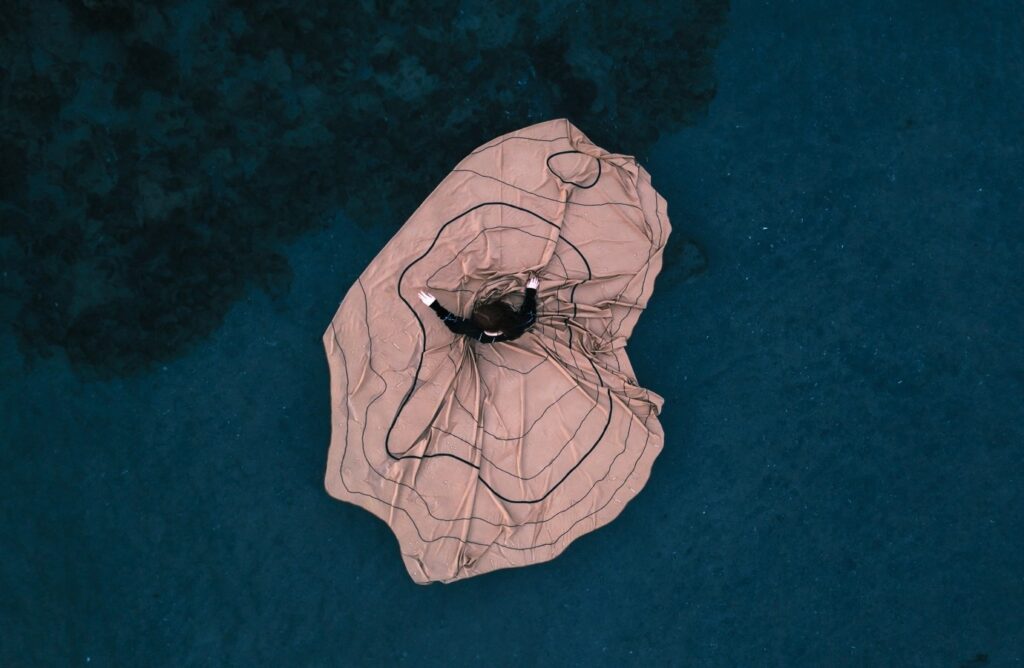
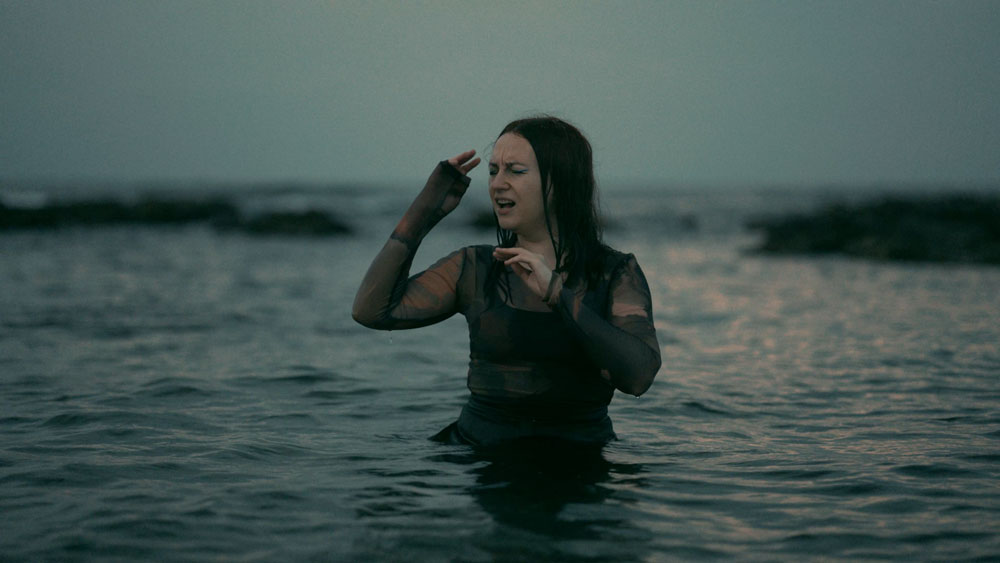
At its most condensed, Black Seas – Scores for the Sonic Eye departs from the Black Sea as a geoecological space where conflict, extraction, militarization, environmental precarity, and deep time do not simply coexist, but become materially entangled. What the work offers is an apparatus for tuning into it. The pavilion is conceived as an acoustic and spatial field where sound, sculptural elements, and moving image operate together—articulating forms of language, drawn from conditions of resistance and survival, as found in microbial life persisting within the anoxic depths of the sea.The project pushes back against regimes of legibility that dominate both geopolitics and exhibition-making. We live in a moment that privileges speed, visibility, evidence, capture. In such a context, landscapes are often rendered either as resources to be managed or as images to be consumed. Black Seas – Scores for the Sonic Eye resists both. It asks what it would mean to encounter the sea not through mastery, surveillance, or extraction, but through attunement.
Why this artist, and why now?
Anca Benera and Arnold Estefán are artists whose practice has, over many years, consistently investigated the ways in which infrastructures of power sediment themselves in landscapes, materials, ecologies, and memory. They have long worked at the intersection of extraction and political imagination, but always in a way that avoids turning complex systems into mere illustration. Both myself and co-curator Diana Marincu have previously worked with Anca and Arnold, with great admiration and believe that their practice in relation to Venice is precisely this rare combination: conceptual rigor, formal precision, and a deep commitment to transdisciplinary research.
With Black Seas – Scores for the Sonic Eye, their work reaches a particularly urgent and mature articulation. The Black Sea is approached as a materially specific environment whose geology, chemistry, and political history make it one of the most charged spaces from which to think the present. It is a sea marked by war, by imperial and post-imperial contestation, by logistical routes, by energy infrastructures, by ecological fragility, and by asymmetrical visibility. Few artistic practices are as equipped as theirs to hold these layers together in an affective exhibition form.
Why now? Because the conditions this work engages are no longer peripheral. They are central to how we understand the planet and its internal fractures. At a moment when the Black Sea region has re-entered public consciousness largely through militarized and strategic narratives, Benera and Estefán insist on another kind of reading—one that attends to the sea as a living archive, a site of suspended histories, chemical processes, and acoustic relations. Their work is timely not because it illustrates current events, but because it reorients the frame through which we perceive long lasting effects on planetary conditions.
What does participation in the Venice Biennale actually change for you—beyond visibility?
Participation in the Venice Biennale changes the scale and complexity. Visibility is, of course, part of the equation, but the deeper transformation lies elsewhere: in the fact that the work enters a highly codified international space where it will be read simultaneously through art-historical, national, geopolitical, and institutional frameworks. The Biennale compresses multiple audiences, expectations, and projections into one stage. For me, the Biennale does not simply amplify a project; it tests it. It asks whether a work can retain conceptual density while moving across contexts. In this sense, the pavilion becomes a site of negotiation: between situatedness within a regional context and openness and relevance for planetary thinking.Beyond visibility, then, Venice changes the density of the discourse around the work. It creates a situation in which curatorial thinking, artistic method, institutional collaboration, and geopolitical position all become more exposed. And that exposure, while demanding, can generate a sharper articulation of what the project is actually doing.
“Central and Eastern Europe” is still widely used as a category—do you find it meaningful, limiting, or outdated?
“Central and Eastern Europe” is one of those categories that persists because it still does institutional and discursive work, even when its explanatory power is limited. It can name certain shared histories: state socialism, postsocialist transition, the persistence of imperial fault lines, infrastructural reordering, and forms of dependency that are both historical and ongoing. In that sense, it is not entirely empty. At the same time, it is undeniably flattening. It risks compressing heterogeneous political, social, and aesthetic conditions into a single regional imaginary, often one produced from elsewhere. It is frequently less a self-description than a framework imposed by curatorial, academic, and market structures that still need the region to appear coherent in order to be legible. That coherence is, of course, partial and often misleading.What interests me is less whether the category is right or wrong than how it functions. Who needs it? Under what conditions does it become useful? And what does it obscure? In curatorial terms, I think one has to work with such categories tactically—neither simply rejecting them nor passively inhabiting them. They can be mobilized to point to specific historical formations, but they must also be interrupted from within. Otherwise they risk becoming a substitute for analysis. It is for sure outdated whenever it pretends that the region can be understood apart from wider planetary circulations of capital, war, ecology, migration, and extractive power. The Black Sea complicates this further. It connects regions, systems, and histories that exceed any fixed category. It is not just “regional,” but part of larger circulations—ecological, economic, imperial. So rather than accepting or rejecting the term, I think it needs to be handled carefully—used when necessary, but never allowed to stabilize into identity.
Do you feel your work is read differently in Western contexts—and if so, is that a misunderstanding, a projection, or something you actively work with?
I’m not sure the work itself is fundamentally read differently, but the conditions in which it is produced and circulated are still very different, and that inevitably shapes how it is encountered.
I have been working for a long time between what are often understood as two “edges” of Europe—Romania, where I am from, and Sweden, where I have been based for almost twenty years. In Romania, there is still a significant lack of sustained cultural infrastructure and long-term funding for the arts. This creates a condition of continuous pressure. You are often working without clarity—budgets are uncertain, timelines shift, decisions come late, and much of the work happens under urgency. Cultural workers are overextended, constantly adapting, often building things from scratch while also trying to maintain a level of criticality and rigor. That condition inevitably informs how projects are conceived and realized. In Sweden, on the other hand, there is, still, a much more stable institutional framework. But that stability creates a need to actively develop discourses that do not remain enclosed within a well-supported system. There is a responsibility to not take that infrastructure for granted, but to use it to build connections across geographies and fields.
This tension has been very formative for me. It has shaped how I think about curatorial work—not as something that happens in a neutral space, but as something deeply conditioned by the environments in which it is produced. This connects to my work at Konsthall C, particularly through the program Decolonizing the North, inscribing decolonization within the Nordic context, including at institutional level, knowledge production and curatorial practice. It also became very clear during my work as part of the curatorial team for Timișoara 2023 – European Capital of Culture, where curating meant not only developing a program, but thinking structurally—how to build conditions and infrastructures that remain beyond the event itself. In the context of Venice, these layers come together quite clearly. Working with the Black Sea means working with a region that is often approached as peripheral, but which in fact operates through multiple connections—ecological, infrastructural, geopolitical. It is important to hold that complexity, and to resist simplifying it into a single narrative.
So rather than thinking in terms of different readings, I would say that I am more attentive to different conditions of production and reception, and to how these shape what becomes visible, what is supported, and what remains under pressure.
At what point in the process did you become most aware of your geopolitical position—and did it open doors or quietly close them?
It becomes very tangible the moment you step into the Biennale structure as a national pavilion. You realize quite quickly that not everyone enters from the same position. There are countries with long-standing institutional visibility, larger production budgets, and stronger networks that shape how their presence is received even before the work is encountered. And then there are contexts like Romania, where you are still negotiating that visibility—where being “on the map” is not a given, but something that has to be continuously asserted. So yes, it opens a platform, but it also exposes these imbalances very clearly. You become aware of how much depends not only on the work, but on infrastructure, continuity, and resources that are unevenly distributed.
Is there such a thing as a shared “Central and Eastern European-ness” in contemporary art, or is that idea mostly imposed from the outside?
I tend to be cautious with that term, especially when it suggests a bounded or internally coherent region. What is often grouped under “Central and Eastern Europe” is in fact shaped by very different trajectories, and more importantly, by connections that extend far beyond the region itself. If there is something shared, it is not identity but exposure to certain conditions—shifting infrastructures, uneven funding, political pressure—but these are not unique. They resonate with situations elsewhere, from the Global South to other parts of Europe, where similar dynamics of extraction, instability, or marginalization are at play. What I find limiting is when the category isolates these practices instead of situating them within these wider entanglements. It can produce a kind of enclosure, where the work is expected to speak primarily “from” or “about” a region, rather than through the multiple relations that actually shape it. So I would say the term persists as a frame, but it becomes more useful when it is opened outward—when it is understood not as a contained geography, but as one node within a much larger set of shared, though uneven, struggles.
What was the hardest decision you made that no one visiting the exhibition will ever notice?
One of the hardest decisions was to work through constraints that were initially very practical, budgetary limits, technical conditions, and the precarity of the building itself which pushed us to think alternative architectural and exhibition design solutions. But an interesting decision was to remove or withhold explanatory layers that could have made the project more immediately accessible. There is always a temptation, especially with a work as research-intensive as Black Seas – Scores for the Sonic Eye, to overdetermine the viewer’s path through context: to provide more data, more references, more geopolitical anchoring, more didactic scaffolding. At a certain point, we made a very clear decision: not to include human language inside the installation in the pavilion in Giardini. We want the work to be encountered through listening, through sensing, through spatial and acoustic relations. This was not about withholding information for its own sake, but about questioning the limits of language itself. We have developed increasingly complex vocabularies, tools, and systems to communicate, and yet we are still faced with profound failures of understanding. So instead of adding more language, we tried to work toward other forms of articulation.
How do you negotiate the line between aesthetics and politics without falling into illustration or overstatement?
For me, the key is to avoid treating politics as content and aesthetics as form, as though one simply dresses the other. In Black Seas – Scores for the Sonic Eye, politics is embedded in the very conditions of materiality, perception, and relation that the work stages. The project is political not because it depicts conflict or cites current events directly, but because it reorganizes how those conditions can be sensed.This is where translation becomes crucial. Oceanographic data, wave turbulence, drifting buoys, underwater currents, acoustic frequencies—these are not presented as informational evidence. They are translated into sonic, visual, and sculptural structures that activate the exhibition space as a resonant environment. That process does not aestheticize politics into abstraction; it asks how art can produce another sensory relation to systems that are otherwise apprehended only through statistics, maps, military language, or media spectacle. The challenge was to create a form that remains materially and sensorially compelling while carrying the weight of ecological and geopolitical tension without explaining it away. The work must remain formally exacting, because form is not secondary—it is where thought becomes experience. And politics must remain more than message; it has to inhabit the structure of the encounter itself.
In your view, is it still necessary for a pavilion to respond to current geopolitical realities—or can disengagement be a position in itself?
Disengagement can certainly be a position, but it is never innocent. To withdraw from explicit geopolitical address does not place a work outside politics; it simply repositions its relation to them. The question, then, is not whether one responds, but how one understands the terms of response. In the context of the Venice Biennale, the pavilion structure is itself geopolitical. It organizes difference spatially and symbolically through national representation. To pretend that one can inhabit that structure, built in 1937 within fascist regimes in Europe and in this decade marked by multiple wars, without engaging its conditions would be disingenuous. Our response unfolds across multiple layers: through the subject of the Black Sea itself, through the extension of the project at the Romanian Cultural Institute, which traces colonial entanglements of extraction from the Black Sea toward other seas and geographies, and through the discursive and resource-based dimension of the project, where the website gathers references and forms of alignment with ongoing struggles for liberation.
What kind of reading—or misreading—of your exhibition would concern you the most?
Ideally, the exhibition remains somewhat resistant to totalizing interpretation. It should hold multiple temporalities and registers together: ecological, historical, sonic, material, geopolitical. If a visitor leaves with a sense that something in their perception has shifted—even without full conceptual closure—I would consider that a meaningful encounter.
What is currently influencing your thinking outside the art world—and why does it matter to your work?
I find it increasingly difficult to separate what influences my thinking from the broader condition we are living through. There is a constant state of assault—material, visual, discursive—that we are witnessing, and it is difficult to work without acknowledging the scale of violence unfolding across multiple geographies: the genocide in Gaza, and the terrible opression and violence on Palestine, the genocide in Sudan, the war in Iran, the long histories and present struggles in Kurdistan. These are not distant contexts; they shape how one thinks and works. What concerns me deeply is not only the violence itself, but how quickly we seem to adjust to it—how easily the language of rights, solidarity, and humanity is eroded or selectively applied. This creates a sense of urgency around what it means to remain attentive, and what forms of solidarity are still possible as sustained positions.
At the same time, ecological thinking has been equally important as a way of understanding interdependence beyond human-centered frameworks, as Lynn Margulis, for example, radically reorients how we think about life as symbiosis.This has implications not only for science, but for how we understand coexistence and survival. These influences matter because they shift how one approaches institutional practice as well. If we speak about decolonization in museums or exhibition-making, it cannot remain at the level of discourse or programming. It requires rethinking what is collected, what is displayed, how knowledge is produced, and who is addressed.