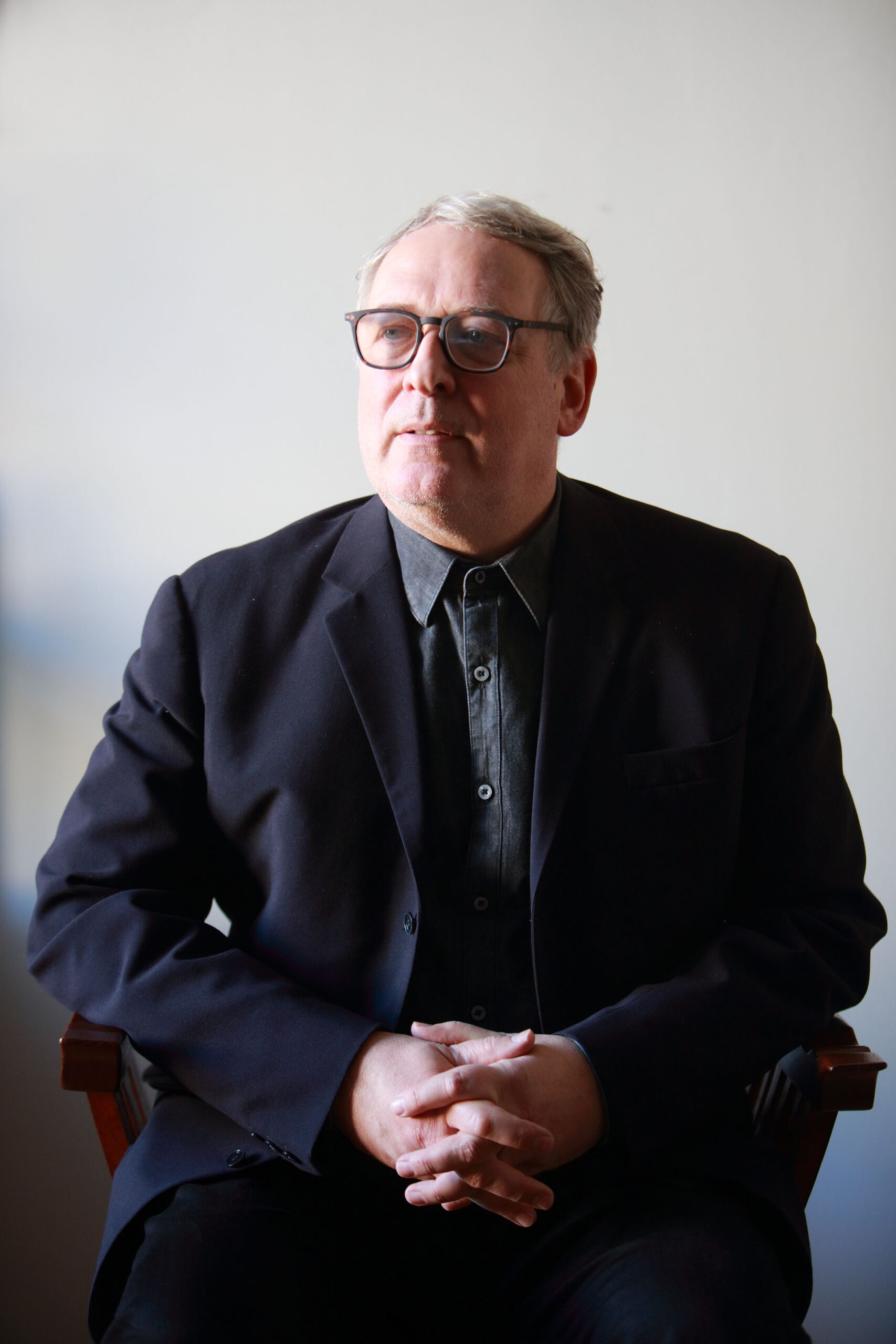
Dubravka Lošić’s presentation at the Venice Biennale is more than just another national pavilion—it is a concentrated reflection on how beauty, trauma, and cultural position intersect. Her installation Compelled by Fright and Beauty reveals the tensions beneath the Mediterranean idyll, while the curatorial perspective probes how Central and Eastern European experience is read within the global art context. This interview explores those layers, addressing the boundary between aesthetics and politics, the dynamics of visibility and misreading, and what it means to participate in the Venice Biennale today.
If you had to distil your pavilion into a single idea, what would it be—and what does it push back against?
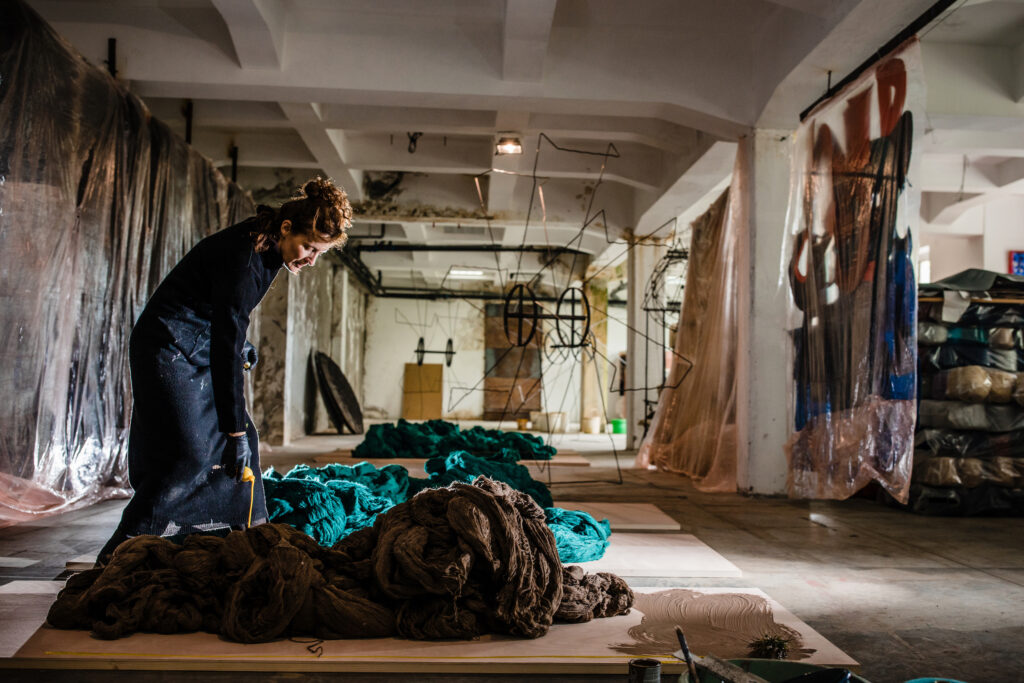
Dubravka Lošić’s installation Compelled by Fright and Beauty at Palazzo Zorzi expresses a dramatic sense of existence. It pushes back against everything imposed on her by the beautiful surroundings of her hometown Dubrovnik, by its siege and the war in the 1990s, by today’s tourist frenzy, and by dominant visual aesthetics. A fuller sense of that tension can also be found on the exhibition website, https://losic.nmmu.hr/ .
Why this artist, and why now?
Dubravka Lošić is unique, a rarity in today’s art world. She shapes bold forms in which modernist, postmodern, neo-avant-garde, local, and traditional creative paradigms converge and reinforce one another. Her artistic language is at once universal, subjective, and local, opening a space for improvisation at the boundaries of form and making the emotional, visual, sensory, and affective power of art accessible to a wide audience. Over the past few years, she has reached one of the peaks of her four-decade-long career, which makes this the right moment to present her on such an international stage.
What does participation in the Venice Biennale actually change for you—beyond visibility?
It certainly adds another layer of intensity to my work as a museum director, but it does not radically alter my professional horizon. I have previously been involved with national pavilions at both the Venice and São Paulo Biennials, so in that sense this is not entirely new territory for me. Personally, however, it feels like a kind of homecoming, since Venice is historically deeply connected to the eastern Adriatic coast, where I come from.
“Central and Eastern Europe” is still widely used as a category—do you find it meaningful, limiting, or outdated?
Actually, all of the above. It is one of those geopolitical and cultural constructs that continue to linger, and you have to deal with them, avoid them, or make use of them depending on the situation. It exposes the fact that Europe is still not fully integrated, although one hopes that this may change in the foreseeable future. Our field reflects that condition at every level of practice: cultural exchange, the dynamics of centre and periphery, influence, visibility, the art market, and broader financial circumstances.
Do you feel your work is read differently in Western contexts—and if so, is that a misunderstanding, a projection, or something you actively work with?
Although visual language is often assumed to be universal, it is always read differently depending on the context—East or West, North or South, centre or periphery. What matters is that the raison d’être of the exhibition comes across and connects with the audience; otherwise, there is little point. I am always trying to understand how to attract attention while achieving the widest possible readability. That requires thinking through many different layers during the processes of conceptualisation, selection, and presentation, but that is precisely what makes curatorial work interesting.
At what point in the process did you become most aware of your geopolitical position—and did it open doors or quietly close them?
You become aware of it almost immediately, the moment you begin working beyond your local scene or immediate circle. Every new context requires a shift in strategy, and that only becomes more complex with distance, as you cross visible and invisible, official and unofficial borders. Sometimes that position opens doors; at other times, it quietly closes them. In any case, it has to be acknowledged and consciously addressed in one’s work.
Is there such a thing as a shared “Central and Eastern European-ness” in contemporary art, or is that idea mostly imposed from the outside?
It is one of many classificatory frameworks used from the outside, often with only a superficial sense of what it actually means. On the other hand, what do “we” really understand about the so-called Western art scene? We often hold equally superficial ideas about others—and about one another. I do not think this category has much real importance for those of us living and working within the assumed region, because poetics are always individual and subjective. Regrettably, we also do not pay enough attention to what is happening within our own so-called region, as our focus remains directed toward the proverbial West, where cultural authority and financial power have historically been concentrated.
What was the hardest decision you made that no one visiting the exhibition will ever notice?
In fact, perhaps thanks to experience, I was immediately certain about which segment of Dubravka Lošić’s oeuvre we should present. The more difficult decisions concerned how to adapt that vision to a highly protected exhibition space without compromising the work’s intensity. These were largely technical and spatial adjustments, invisible to the visitor but essential to the final result. As always, the artist–curator relationship involves a certain intensity throughout the phases of production and realisation, but ideally that energy remains fully absorbed into the exhibition itself.
How do you negotiate the line between aesthetics and politics without falling into illustration or overstatement?
That is precisely what Dubravka’s work is about. It is emotionally and visually compelling, yet its roughness and rawness speak powerfully about the drama of living and working in one of the most beautiful places in the Mediterranean—a place marked not only by beauty, but also by trauma, war, and siege. Still, there is no didacticism, no explanatory text: only form, texture, colour, and the cumulative force of their combinations. That is where the political dimension of the work resides.
In your view, is it still necessary for a pavilion to respond to current geopolitical realities—or can disengagement be a position in itself?
This has certainly become a pressing issue in recent years, but I do not think it belongs to the historical mandate of the national pavilion in any narrow or prescriptive sense. At the same time, every pavilion represents a reality, just as art always does, even at the most subliminal level. Engagement is always a choice, for both artist and curator. Disengagement, in turn, can also be understood as a passive form of engagement. The curatorial task is to select an artist and a body of work, and to shape an interpretation capable of holding all of these tensions, including the dilemma between engagement and disengagement.
What kind of reading—or misreading—of your exhibition would concern you the most?
I would be concerned if the public were to remain only at the level of the obvious—at the formal and visual qualities, and even at the uniqueness of Dubravka Lošić’s work—without recognising the deeper emotional, historical, and existential tensions it carries.
What is currently influencing your thinking outside the art world—and why does it matter to your work?
Culture in the broadest sense continually shapes my thinking; I simply cannot imagine life or work without it. What influences me most is not only art, but literature, film, history, politics, and the complexity of everyday life itself. Humanity remains an inexhaustible source of joy, curiosity, sadness, and despair, and all of that inevitably enters the way I think and work.