An interview with Luca Cserhalmi, curator of the Hungarian Pavilion at the 61st Venice Biennale, on Pneuma Cosmic, slowness as resistance, the crisis of scientific worldviews, and the possibility of building intuitive relationships with the world through art.
If you had to distill your pavilion into a single idea, what would it be—and what does it push back against?
Our project presents a specific idea, a fictional concept. Pneuma Cosmic is about the all-pervading, invisibly vitalizing force of air, which could best be translated as a cosmic breath. It is the medium that connects all living and non-living things, yet we do not pay enough attention to it. The aim of the project is to propose an alternative approach to the phenomenon of airflow—one that, in contrast to conventional scientific knowledge production, explores deeply subjective, metaphorical, and intuitive modes of connection.
Why this artist, and why now?
Koronczi Endre has been working for nearly two decades on his air-movement-based art project, Ploubuter Park. What he represents within the discourse of nature-related visual art, as well as in his earlier projects, is very appealing to me: instead of constructing the background of his works just around social issues and crises, he immerses himself in the given phenomenon (air movement), seeking to grasp and understand its essence as deeply as possible, while developing an active relationship with it. I find this approach particularly refreshing and relevant.
This is complemented by Endre’s in his own way rebellious artistic attitude, which is important not only for the coherence of his oeuvre but also as a model of human conduct: in his art, he consistently searches for freedom. This is also why, at certain stages of Ploubuter Park, he has stepped outside institutional frameworks and moved his practice into nature.
What does participation in the Venice Biennale actually change for you—beyond visibility?
As a curator and visual artist in Hungary, it is not easy to reach an international audience, even though the desire and need for connection are clearly present. Participation in the Venice Biennale carries particular responsibility, as many professionals in Hungary are working to build stronger connections with the international scene—efforts that need continued reinforcement. I believe that a pavilion with a distinctive voice at the Venice Biennale can draw attention not only to the exhibiting artist, but also to the broader artistic milieu of the country.
The context of the Biennale has also shaped many aspects of the project’s development: Pneuma Cosmic is fundamentally a slow, quiet, contemplative exhibition. For visitors wandering for days among numerous pavilions and exhibitions, saturated with visual stimuli, this might even seem like a misstep—but in fact, we aim to counteract haste and superficial reception. To encourage slowing down, we employed various strategies: the acoustic elements, the kinetic installation, and the rhythm of the videos all serve this purpose. One could also say that the atmosphere of the space itself is capable of subtly influencing the viewer. To help refocus scattered attention, we present four large-scale installations that guide the visitor. The final piece is distinctly minimalist, operating at the threshold of visual perceptibility.
“Central and Eastern Europe” is still widely used as a category—do you find it meaningful, limiting, or outdated?
I believe that geographical categorization should not be seen as a burden; geological conditions, history, and cultural habits can always serve as sources of a distinct strength—one that may be meaningful not only locally but can also contribute productively to international discourse. Global issues manifest differently in our region, shaped by specific contexts and emphases.
The exhibition catalogue includes a text that is a transcript of a conversation between Koronczi Endre and Németh Ilona visual artist. At many points, their discussion touches precisely on these specific questions, going back as far as the beginning of Koronczi’s career in the 1990s. The emergence of gender issues, social engagement, independence and public art all represent defining moments in different phases of Endre’s oeuvre—issues to which he was able to formulate responses within a particular regional context.
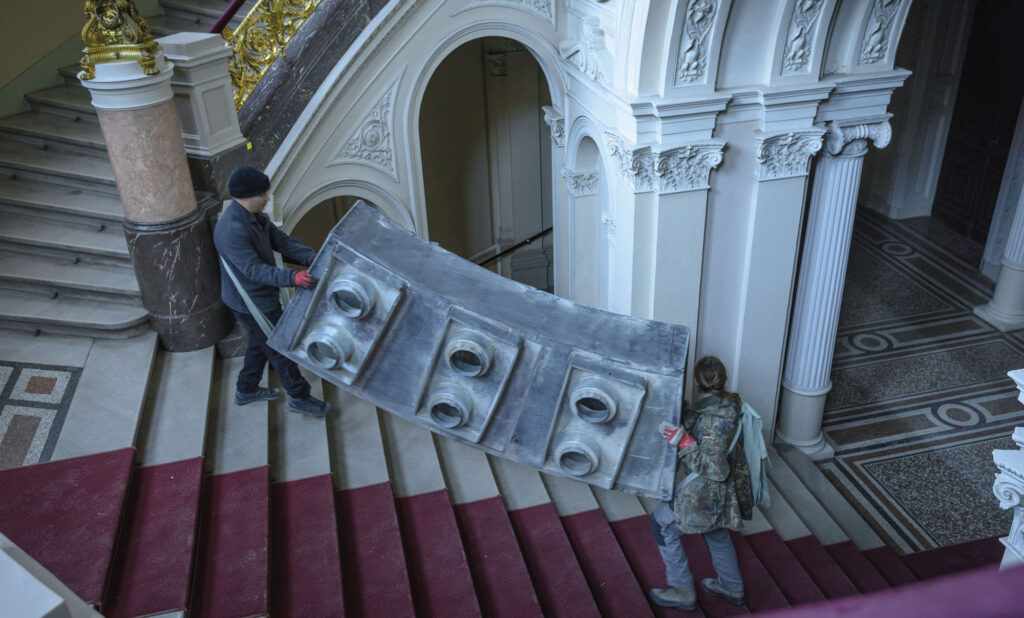
From this perspective, one important interpretive layer of the Pneuma Cosmic project reflects on the crisis of science, as well as on the condition of Hungary’s scientific community and institutional system. As a memento of this, we present an installation titled Trapped Breath, constructed from elements of the ventilation system dismantled from the historic headquarters of theHungarian Academy of Science. The erosion of trust in the scientific worldview, the resulting crisis, the former prestige of science, and the importance of critically restructuring dialogue—as well as questions surrounding non-scientific knowledge production and the role of experiential or non-rational forms of knowledge—all emerge through these dusty objects. What we exhibit is a concrete physical artifact with its own specific history, yet the questions it raises are universal.
Do you feel your work is read differently in Western contexts—and if so, is that a misunderstanding, a projection, or something you actively work with?
The Pneuma Cosmic project articulates ideas and propositions that are globally accessible and interpretable. I do not believe that the exhibited works can be misunderstood. If that were the case, it would mean that we had made a mistake—since, on an international stage addressing an international audience, it is essential to ensure that everyone can understand the message and context of the pavilion.
At what point in the process did you become most aware of your geopolitical position—and did it open doors or quietly close them?
We tried to turn every disadvantage into an advantage. Several countries in our region, like us, struggle with the low budgets of their pavilions. We took this very consciously into account already when preparing the proposal. We decided that, precisely for this reason, we would not compete on technical or technological execution, but instead develop the concept of the works through a distinctly analog and recycling-based approach.
In terms of my own curatorial practice, this is familiar terrain, as I have often had to create exhibitions “out of nothing.” These motifs are also recurring in Endre’s art; in fact, the DIY mindset and the often “Central and Eastern European”–labeled bricolage and handmade solutions are close to him as well.
A particularly beautiful and intentional example of this approach is that the artwork descriptions in the pavilion are handwritten directly onto the walls. Another, almost ironic connection is that in the installation built from the previously mentioned ventilation elements, we essentially rescued discarded waste and elevated it into an artwork. At the same time, this gesture is significant from another perspective as well: it reflects an appreciation of utilitarian objects, and amplifies the stories and metaphorical ideas embedded within them. In light of all this, I believe that although the planning process was challenging, the project and the exhibition did not suffer from it—on the contrary, the limitations of the budget helped define key conceptual elements of the work.
Is there such a thing as a shared “Central and Eastern European-ness” in contemporary art, or is that idea mostly imposed from the outside?
In this area there is a significant divide between post-Soviet nations and those that embarked on a democratic path immediately after World War II. Some countries have been able to address this more quickly, others more slowly. This remains a determining factor not only in terms of cultural policy and cultural funding, but also in the history of visual culture and in the persistence of outdated strategies that have survived as remnants of former artistic institutions. If we were to speak in general terms, we could say that these inherited challenges lead to unequal conditions. At the same time, there are many aspects within contemporary art discourse—whether related to art theory, media, formal language, or global issues—that can be considered universal phenomena.
What was the hardest decision you made that no one visiting the exhibition will ever notice?
The installation titled Both Feet Above the Ground set out to identify and present the most important sigh. The work consists of three units: a twelve-hour pilgrimage video documenting the search for the sigh, in which Koronczi Endre carries, over the course of a year, a glass object in a specially designed backpack—an object intended to eventually capture this “most important sigh”; the glass object itself, containing the said most important sigh; a video capturing the very moment of collecting the most important sigh. From the very beginning of the project, Endre and I had extensive discussions about what makes a sigh the most important. A wide range of arguments and counterarguments emerged regarding the criteria and the dramaturgy of the resulting video. The final decision was truly made at the very last moment. It was a unique experience to think this question through together. In the end, the most decisive aspect was that the “most important sigh” should not be tied to a specific individual, since the sigh—and the need for air—of every being is equal and ultimately converges in the atmosphere: this is the essence of Pneuma Cosmic.
This decision was difficult precisely because of its singularity and weight, but selecting the entries, images, and videos for the Floating Hypothesis installation proved equally challenging. The initial pool of contents was much larger than what is ultimately presented in the exhibition, but considerations of space, accessibility, and focus required careful selection. Since we co-authored the entries and both proposed images and videos that were important to us, every decision was thoroughly weighed in order to create the most comprehensive associative map possible for the concept of Pneuma Cosmic.
How do you negotiate the line between aesthetics and politics without falling into illustration or overstatement?
In all cases, it is essential to employ the specific tools, reflexivity, and language of art itself, which is primarily the responsibility of the creators in order to prevent artworks from becoming merely illustrative. The curator’s role is in critical selection—that is, to ensure that the greatest value of the works presented in an exhibition does not lie solely in their thematic reflection of the curatorial concept, while remaining otherwise superficial.
Overstatement can also have its place, provided it is accompanied by sufficient critical self-reflection, rebellion, or humor. At times, I feel that there are too many overly polished artworks.
In your view, is it still necessary for a pavilion to respond to current geopolitical realities—or can disengagement be a position in itself?
The situation of the Venice Biennale is very specific; however, what continues to interest me most in the individual exhibitions is artistic production and achievement. If the discussion of geopolitics were to become the dominant factor in every pavilion, the Biennale would lose part of what makes it one of the most outstanding events in the visual arts. It would be counterproductive to make selections based on such criteria.
Of course, there are nations in such current circumstances that it would be hypocritical to remain silent about, and these issues affect everyone. However, we should not narrow our field of vision or the scope of art to this. In summary: whether I feel it is necessary to address a given topic within a pavilion depends on the geopolitics of the given nation. In other cases, in my view, it is not a matter of either detachment or taking a stand, but rather the autonomous thematic nature of the selected project, which cannot be reduced to such a dichotomy.
What kind of reading—or misreading—of your exhibition would concern you the most?
It was important for us that it be clear to the audience that we are not approaching the natural phenomenon from the perspective of the climate crisis narrative, but instead foregrounding the metaphorical layers of air movement. At the same time I think that the metaphorical approach can be particularly useful in the field of environmental awareness, since it aims precisely to create personal attachment, empathetic attention, and connection. In order for this to be possible, we wanted to create a context in the exhibition space and beyond that is not based on a situation burdened by crisis narratives. Related to this, the two motifs that are central to the exhibition—techniques of slowing down and walking—are also tools of social resistance that need to be taken into account and can be used.
What is currently influencing your thinking outside the art world—and why does it matter to your work?
I do a lot of hiking, and time spent in nature and physical exercise mean a great deal to me. In these moments I actively experience processes of slowing down, silence, and attentiveness, as my sense of a close relational network with nature and my experience of being embedded in the environment come into the focus of my awareness. I consider this experience and way of thinking very important to communicate, which I also strive to assert as effectively as possible as a member of the Research Centre of Aesthetic, Nature and Environment environmental aesthetics research group and as a curator.