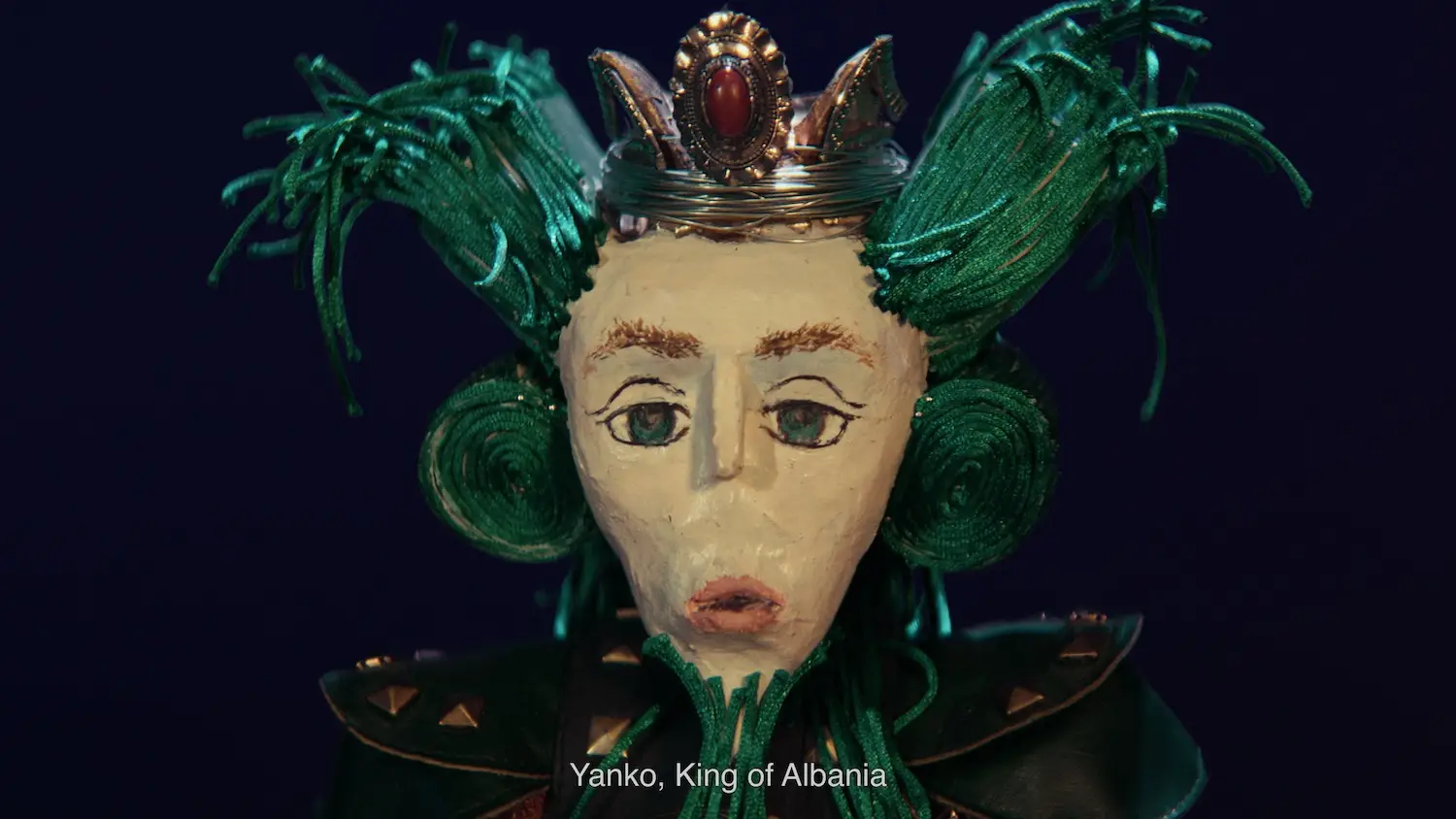
This interview with the Albanian Pavilion’s curator, Małgorzata Ludwisiak, explores A Place in the Sun through questions of cultural perception, the notion of the “unknown,” and the mechanisms of the exoticizing gaze, while also reflecting on broader geopolitical and artistic contexts.
If you had to distill your pavilion into a single idea, what would it be—and what does it push back against?
At the heart of A Place in the Sun by Genti Korini lies a simple question, yet of great depth and relevance: how do we perceive countries and cultures which we don’t know? What are our projections about the unknown? What kind of fears or attraction does it trigger? And what is the structure of the exoticizing gaze? Isn’t it too similar to the colonising one? Albania is a case study for these questions in a very indirect way. The artist uses the unknown to tell about the unknown – for example by using Zaum, an experimental, transrational language designed by the avant-garde of the early twentieth century – and the whole story starts to become more complicated and multilayered in a beautiful and powerful way, using puppet theatre, acting and computer-generated imagery.
Why this artist, and why now?
We were introduced by Chus Martines in the summer last year. I was impressed by the quality of Genti’s works, their erudition, and multilayered structures, which he builds by connecting historical references with the present moment in his paintings, photographs or videos. And when he came up with the idea of his project for the Albanian Pavilion and proposed to participate in the national competition, I was sure that it would be a hit and that we had to give it a try. Why? First, because I felt that it was a very careful and smart diagnosis of Albania as a case of a “minor culture” – unknown, and therefore giving rise to speculations about it, triggering our projections. And secondly, the unknown seems to be a major condition defining our times. The whole global system is reaching the edge of chaos and we live in societies of uncertainty. At the same time, Genti Korini doesn’t let us fall into escapism – he immerses us in the middle of what is unknown in the outside world and within ourselves. So from the very beginning I have found this work extremely relevant to the here and now.
What does participation in the Venice Biennale actually change for you—beyond visibility?
The Venice Biennale is a unique platform for conversation between the pavilions, the artists and curators from most of the world. So for me it’s great to contribute to it, to add mine and Genti’s voices to the global discussion held in the visual language.
“Central and Eastern Europe” is still widely used as a category—do you find it meaningful, limiting, or outdated?
Well, this is a very broad topic, of course, which goes far beyond what can be covered in this interview. But if I am to answer in a nutshell – I think it is very untrue and artificially imposed on some geographical territory by the so-called “West”. The whole European culture is founded on the same historical base, which is the Greek-Roman heritage and a Christian one. Genetically we have mixed over thousands of years, so you can’t construct any racial argument. There are dozens of languages spoken in the eastern part of Europe, coming from very different branches. The only experience that we truly have in common is the communist regimes and political dependence on Russia for around 40 years after World War II, which was imposed on our part of Europe by a few political world leaders. And this is some kind of shared trauma for my and older generations. But not for Gen Z anymore. Another shared experience is the poor economic situation of these countries – both in communist times and after regaining their independence and becoming subject to capitalist colonisation in the nineties and 2000s. But nowadays many Eastern European economies are doing better than some Western ones, so again it’s hard to build a division line around economy so much now. The Iron Curtain has been over for about 35 years. We have been reading the same books for centuries and watching the same films ever since cinema was invented. We share the same holiday destinations in Italy, Spain or Greece. If there is some difference, other than the economic one, it is produced within the Western eye. And to some extent this is also a subject of Genti Korini’s A Place in the Sun project.
Do you feel your work is read differently in Western contexts—and if so, is that a misunderstanding, a projection, or something you actively work with?
It is hard to measure, I think. But it would be interesting to conduct some audience research of this kind. Among professionals I have a lot of great experiences, for example working for the last 6 years as a part of the CIMAM board. We were all peers, coming from all the continents, with a lot of mutual respect and ready to learn from each other. And in terms of the Albanian Pavilion – I am very curious about the feedback which we will get from the public, press and art critics. The core of the work of Genti Korini is about projections – about Albania or any kind of the Other, any “minor” culture that we don’t know. And it might be some Polish, Brazilian or Chinese person producing projections about any unknown place, not necessarily Albania. In his work, Korini universalises the exoticizing gaze to some extent. In the reader accompanying the pavilion, published by Mousse, one of the essays is by Joselina Cruz – director and curator at the Museum of Contemporary Art and Design in Manila, Philippines. She analyses in a super interesting way projections about Albania, which became a part of an important work by a Philippine national poet from the 19th century. And what did Albanians of that time know and imagine about the Philippines?
At what point in the process did you become most aware of your geopolitical position—and did it open doors or quietly close them?
I did my MA in history of art in 2001. Poland was still suffering the consequences of the political and economic transformation of the nineties and it was just before joining the EU. So I was perfectly aware of all the limitations of my geopolitical position. The generation of my colleagues, born a few years earlier and active in the contemporary art field in the nineties, might have experienced some doors opening because of the fact that they were professionals from behind the Iron Curtain. At that moment Polish contemporary art was “discovered” by the West, exhibited and consumed by the art market, as an exotic novelty. When I was starting as a young professional, this wave was just passing by. So no special treatment anymore.
Is there such a thing as a shared “Central and Eastern European-ness” in contemporary art, or is that idea mostly imposed from the outside?
I don’t think we have any characteristics of contemporary art belonging to the region. There was a moment in the nineties, when there were some shared artistic strategies or languages of artists from, for instance, Poland, East Germany or the Czech Republic, as they were confronting a similar reality: societies and countries in transformation, brutally colonised by Western capital. But that was already more than two decades ago. Nowadays I find the artistic landscape of the countries in Eastern Europe very diversified and linked to global systems. If anyone tries to label it as “Central and Eastern European”, it must be for marketing reasons or a lack of proper knowledge, in my opinion.
What was the hardest decision you made that no one visiting the exhibition will ever notice?
Fortunately, there was no such decision to be taken in this case. The hardest challenge was the very narrow space of the pavilion. But in my view we have managed it in the best possible way.
How do you negotiate the line between aesthetics and politics without falling into illustration or overstatement?
I just avoid art or artists falling into them! I am allergic to intellectual or artistic populism. One of the reasons why I was so much attracted by Genti Korini’s work and his idea for the pavilion was his complex and nuanced way of thinking and building up the structure. The way A Place in the Sun shifts between different historical times, past and future, and ideas of language or the Other, can be read in multiple ways, but at the same time it is very relevant. I think that on some level this work is confronting a modern world that is reverting to an arena of hostile, warring tribes. So it is touching the core of the global political situation, not the surface of it.
In your view, is it still necessary for a pavilion to respond to current geopolitical realities—or can disengagement be a position in itself?
From my point of view, the most important category for an artwork is whether it offers some unique experience to us: be that an intellectual or affective one. If it changes our gaze, our perspective, if it does its work, it can engage us in social or political realities, even if it’s abstract or poetic. If it doesn’t – the work turns into journalistic commentary or a nice, saleable object. So I personally expect from the works in the pavilions to offer this kind of experience and, by doing so, to be relevant.
What kind of reading—or misreading—of your exhibition would concern you the most?
Probably if someone thinks that this is a work about Albania. Or about the Zaum language of the first avant-garde. A Place in the Sun is a piece which is precisely orchestrated on many levels, creating a space for our confrontation with the unknown, with our fears and projections. I encourage everyone to spend at least 17 minutes in the pavilion, which is the length of the video work, and let oneself immerse in it.
What is currently influencing your thinking outside the art world—and why does it matter to your work?
I simply try to understand the mechanics of the processes that govern our reality – what their dynamics are, what drives them, and where they will lead us. That’s why I have been reading a lot about the climate catastrophe, social sciences, history with its repetitive patterns, and psychology, but also about systems present in physics or biology – without them it is impossible to understand the world surrounding us and the edge of chaos which we are reaching. Genti Korini had a very powerful intuition about the very structure of the process of othering, which defines so much of our times. A part of my role in this project was to unpack his synthetic, visual language and develop it into texts, discursive formats or a publication with amazing analyses commissioned from outstanding art historians or anthropologists coming from Eastern and Western Europe or from the Philippines. The title of the reader is A Place in the Sun. On Staging the Unknown, Decolonisation and Contemporary Art. And I believe that this is exactly the broader picture which we can see through the lens of Korini’s work for the Albanian Pavilion.