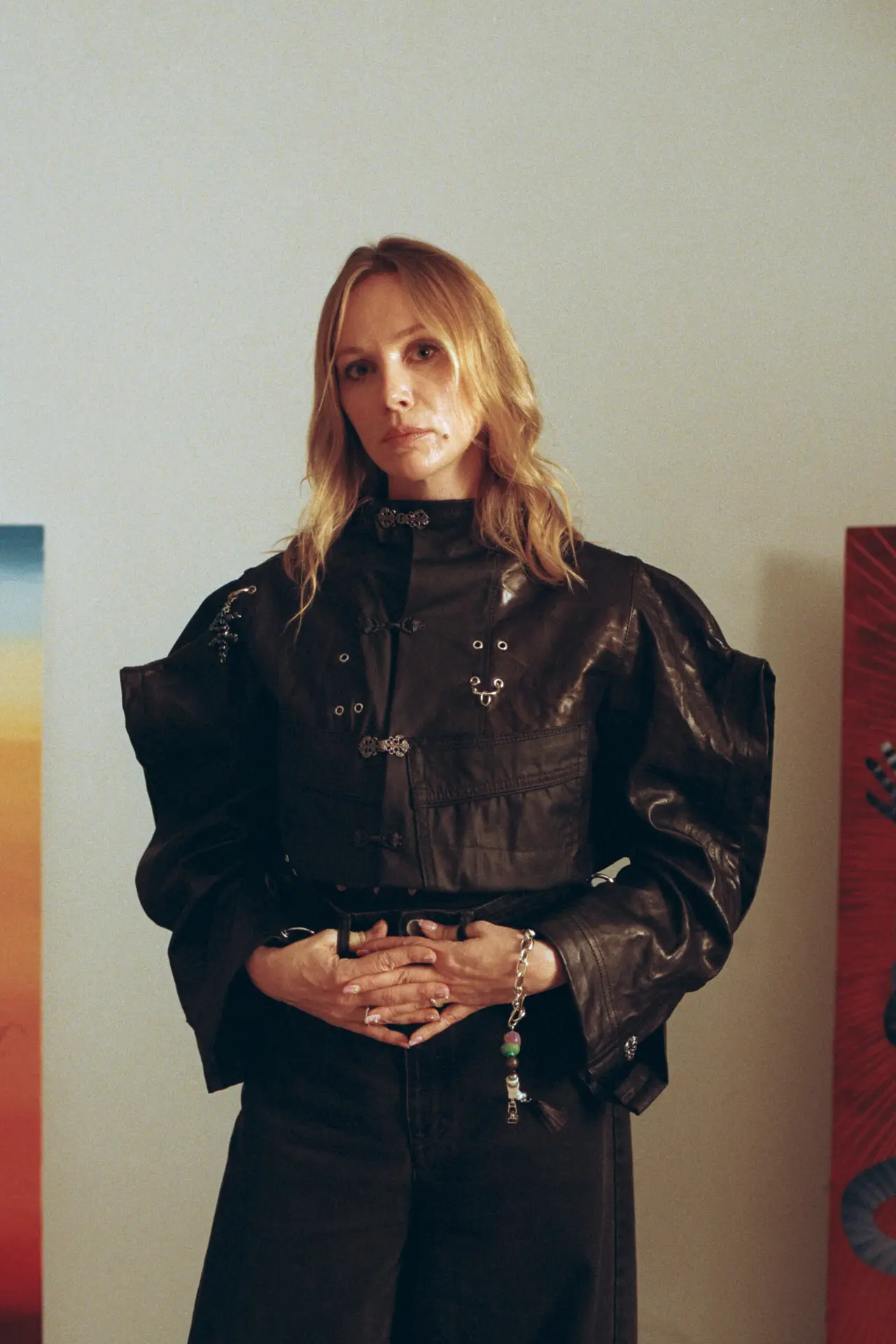
The Easttopics team spoke with Natalia Sielewicz, curator of the Estonian Pavilion at the Venice Biennale, featuring artist Merike Estna. The interview touches on the politics of waiting as an artistic form, the relationship between care and painting, the contradictions of Eastern European identity, and what it means to make art amid ongoing geopolitical and emotional crises.
If you had to distill your pavilion into a single idea, what would it be—and what does it push back against?
World-making understood as a labour of waiting—one that pushes toward open-endedness and imagines painting as something that might bleed beyond its formal boundaries, remain unfinished, or require ongoing care rather than being turned into an object of consumption.
Why this artist, and why now?
Merike Estna is a painter who gently braids together meditations on motherhood and the lineages of women artists who carved paths toward artistic self-determination. Waiting, as a feminized form of endurance, returns here as a form of care bestowed upon a painting that grows to the limits of the pavilion. Neither battle scene nor landscape in service of the nation-state, her 19-metre long canvas will arrive slowly. The canvas is worked lying down and standing up, touched in both horizontal and vertical orientations, tended to as something that, like desire, must be kept alive. In a broader sense, it becomes a metaphor for everyday feminism – creation is not thunder or command, but the slow choreography of care and maintenance, something our world desperately needs right now.
What does participation in the Venice Biennale actually change for you—beyond visibility?
Working with artists and assisting them in creative journey is what ultimately drives me through life. Accompanying Merike in this ambitious project has been very rewarding and I look forward to seeing how audiences will respond to the process of transforming the pavilion in real time. Simultaneously, I am hoping to see beyond the official biennale circuit how different forms of solidarity might emerge during an ongoing geopolitical crisis also in more fragile, less legible spaces—in readings, in gestures, in temporary constellations like Poetry for Palestine by Bidoun Projects, or in other yet-unformed encounters.
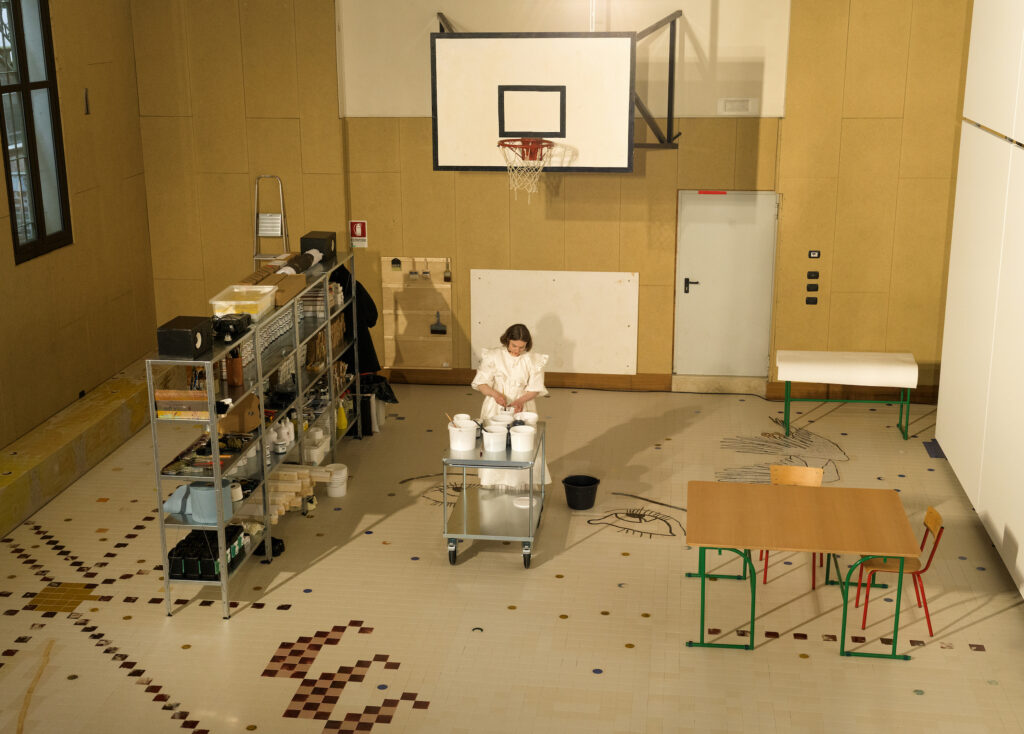
Venice Biennale 2026. Courtesy of CCA. Photo by Agne Raceviciute
“Central and Eastern Europe” is still widely used as a category—do you find it meaningful, limiting, or outdated?
Eastern Europe has seen competing historical narratives used to justify power, borders, and identity. As long as the term does not flatten very different cultural, social, and artistic experiences into a single narrative it may offer a profound insight with the political and historical dynamics that the West is only beginning to confront. There is a Western tendency to read the region east of the river Oder as homogeneous and monoethnic, when in fact it is not and the attempts at homogenization were made through violence—ethnic cleansing, shifting borders, forced migrations. And today, as the region faces yet another radical transformation, it offers urgent lessons for Europe at large.
Do you feel your work is read differently in Western contexts—and if so, is that a misunderstanding, a projection, or something you actively work with?
Merike actively works with a myriad of projections—especially around what it means to be an artist and a mother. There’s something intimate and whimsical in the act of caring for something that is both deeply personal and somehow larger than you. In this case, both the offspring and the artwork. We are also bringing in craft and folk references that are specific to Estonia, which inevitably shape how the work is read.
At what point in the process did you become most aware of your geopolitical position—and did it open doors or quietly close them?
I became very aware of my Eastern European-ness in the early 2000s, when I moved to London to study. That sense of otherness has since been somewhat diluted through the multicentric interconnectedness that the art world offers—at least to some of us working within it. More recently, however, the war in Ukraine has made that awareness resurface with urgency, reminding me how quickly perceived distance collapses, and how deeply these histories and geographies remain entangled in our present.
Is there such a thing as a shared “Central and Eastern European-ness” in contemporary art, or is that idea mostly imposed from the outside?
It’s important to distinguish the specific histories and idiosyncrasies that shape each country’s experience. However, if there is something shared, I would describe it less as a fixed identity and more as an affective condition. Laurel Berlant’s idea of “cruel optimism” resonates here—the constant movement between hope and disillusionment, the desire for a “good life” alongside the pressure to overcome the perceived failures or shame of the past. That emotional register can be a point of connection.
What was the hardest decision you made that no one visiting the exhibition will ever notice?
Resisting the urge to overexplain—while respecting the artist’s integrity and intuition. Artists often know very well what they are doing, even when the process appears chaotic. There’s something magical when our chaos meets theirs. It’s a bit like writing a poem or cooking a soup—you adjust, you taste, you trust the process, and you stop before it becomes too controlled.
How do you negotiate the line between aesthetics and politics without falling into illustration or overstatement?
It really depends on the project. For me, it’s about allowing meaning to emerge through form rather than forcing it into a didactic structure.
In your view, is it still necessary for a pavilion to respond to current geopolitical realities—or can disengagement be a position in itself?
I think, as a society—not only as art professionals—we are experiencing a crisis of agency. The signing of letters, the circulation of appeals, the call for boycotts all continue, and I still participate in them—I find them necessary—even if they unfold alongside a stubborn “business as usual” and the arrogance of those in power. I admire gestures of complete boycott, but I’m wary of how easily absence can be absorbed, leaving existing structures intact and unchallenged.
What kind of reading—or misreading—of your exhibition would concern you the most?
We work against this climactic expectation that you show a highly polished finished work for the opening of the Biennale. To stretch it and bring additional situated moments of togetherness, such as the School of Secret Weather – an educational program which will unfold in the summer time in our pavilion matters to me the most.
What is currently influencing your thinking outside the art world—and why does it matter to your work?
Right now, I am thinking a lot about the affective states of panic and grief in the world, and how they seem to operate on different emotional registers within the same fractured geopolitical reality. Panic feels immediate, urgent, almost hallucinatory, while grief lingers, stretches, and settles into the body over time. Living suspended in this sensorial hell shapes how I approach art and writing—it pushes me to work through dissonance, to hold contradictions, and to make space for both intensity and limbo at once.