As the curator of the Slovenian Pavilion at the Venice Biennale, Nataša Petrešin-Bachelez approaches the exhibition not as a stage for representation, but as a space for resonance, care, and critical reflection. Through Soundtrack for an Invisible House by Nonument Group, she explores forgotten histories, fragile architectures, and the persistent search for dignity amid the ruins of war—challenging the entanglement of power, spirituality, and propaganda while opening space for slower, more attentive forms of listening.
If you had to distill your pavilion into a single idea, what would it be—and what does it push back against?
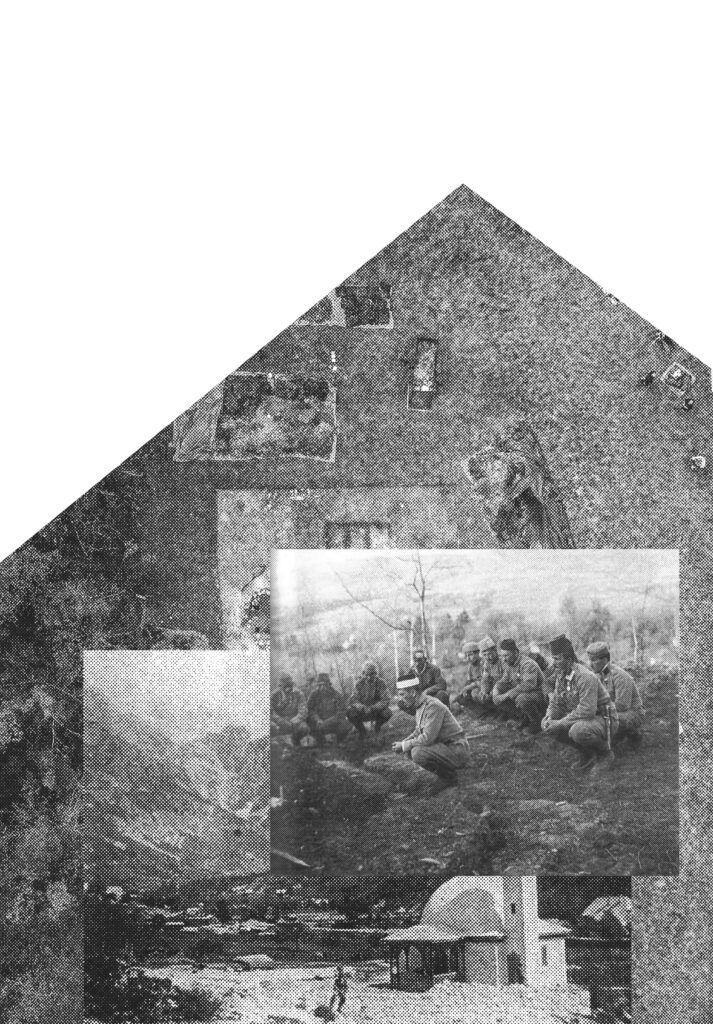
The project Soundtrack for an Invisible House by Nonument Group is a multi-vocal and multi-directional story of the ruins of a white-painted wooden mosque stood for few months in 1917, during the World War I, on a meadow between the Alps near Slovenia’s northwestern border. The project stands as a metaphor of incessant searching for human dignity in times of civilizational ruins. It pushes against entanglements between power, spirituality, and wartime propaganda, shameful millenia-old and yet so contemporary practices.
Why this artist, and why now?
As a curator, I research life-affirming artistic practices that operate on long-term engagement, empathic listening and context-responsiveness. I truly believe in the values of friendships and care that they enable within professional fields and their contribution to instituting new methods or even instutitons. The collective Nonument Group and our scientific collaborator Anja Zalta have been accompanying me personally and professionally since 30 years and contributed thus to much of my creative thinking. I value their personal and political views and I believe we are striving together to create meaningful resonances for the public of the Venice Biennale in the light of the current catastrophy of which we are all witnesses.
What does participation in the Venice Biennale actually change for you—beyond visibility?
I am very happy to be able to contribute to the visibility of the Nonument Group, who has been working since years on the cases of what they call “nonuments”, hidden, abandoned, erased or forgotten architectures and public spaces whose meaning has been transformed due to political or societal changes. With our project, we contribute also to continous questioning of the Venice Biennale’s model of the national representation and, hopefully, to the idea of the necessity for its complete transformation.
“Central and Eastern Europe” is still widely used as a category—do you find it meaningful, limiting, or outdated?
I find it meaningful, as it very much situates and defines me individually and professionally.
Do you feel your work is read differently in Western contexts—and if so, is that a misunderstanding, a projection, or something you actively work with?
I believe in frequencies and resonances and that the projects I do create them in order to sustain conversations, for different readings that might come from the public that lives on the same street, or in different geopolitical realities.
At what point in the process did you become most aware of your geopolitical position—and did it open doors or quietly close them?
When I moved in 2005 from Slovenia to France, I became aware that any accent is a tool. However, doors (of perception) are opening and closing all the time, no matter the accent.
Is there such a thing as a shared “Central and Eastern European-ness” in contemporary art, or is that idea mostly imposed from the outside?
Materially, spiritually and conceptually, art comes from a place of situated imagination and of lived experience. Sharing time and defined space creates similarities and possibilities for categorisation, I don’t think that this is something that would be imposed from the outside of that space.
What was the hardest decision you made that no one visiting the exhibition will ever notice?
A decision that no one will ever notice, but that with the team we continue debating and working on in our future projects.
How do you negotiate the line between aesthetics and politics without falling into illustration or overstatement?
This is a question for an essay, if not a book, and to answer properly and shortly, I would say that for me it is important to stay honest and humble in whatever contexts I work, to myself, to the artists and the collaborators, and to the audiences to whom the work I do is destined for. And to lead the partners and other stakeholders, when they see things divergently different than I do, in a caring way to a dialogue.
In your view, is it still necessary for a pavilion to respond to current geopolitical realities—or can disengagement be a position in itself?
Both illustrative responses to current geopolitical genocides and ecocides and seemingly disengaged positions speak about the moment in which they have been brought to life and to visibility. The methods are various, and even a seeming no-position is today read as a position.
What kind of reading—or misreading—of your exhibition would concern you the most?
We would like that the installation is perceived as a whole made of many entangled parts – a soundtrack with vocal composition, a visual object of the never-ending ruins, an interactive work, a publication including historic, sociological and aesthetic analyses of the mosque’s history – that invite one to slow down their hasted pace and listen to the story that the ruins speak, attentively.
What is currently influencing your thinking outside the art world—and why does it matter to your work?
Non-human consciousness and meditation on impermanence and interdependence: I feel that they bring me some analysis when I try to comprehend where the evil that a human can do and cause, arises from, and how mesmerizing wonders still can be born out from the ruins and killings.