“The mole is no longer a figure of childhood imagination, but an instrument of invisible soft power” — this year’s project at the Czechoslovak Pavilion interprets silence not as passivity, but as a form of political resistance. According to the artists, the Biennale is not only about representation, but also about negotiating how art can be produced today amid authoritarian tendencies, the dismantling of cultural institutions, and the hollowing out of national narratives. At the same time, the project reflects on the external labeling of Central and Eastern European identity and explores how fiction, slowness, and silence can become spaces for an alternative political imagination.
If you had to distill your pavilion into a single idea, what would it be—and what does it push back against?
At its core, the pavilion revolves around Mr. M. and his silent instruments. The mole, once a figure of childhood imagination, of interspecies kindness and a world that aspired to be just, has been quietly conscripted into soft power. It has shifted from something open and affective into a mechanism that operates below the threshold of visibility: unthreatening, universally acceptable, invisible. A perfect diplomatic figure precisely because it no longer says anything.
But the mole carries other resonances too. Marx used the mole as a figure for the proletariat, moving beneath the surface, out of sight, building pressure. The burrow in Kafka’s story is both sanctuary and site of anxiety, a place where an inexplicable hum begins to penetrate, impossible to locate, impossible to ignore. We found both of those layers already inside the figure we’d chosen, and the pavilion tries to hold them together.
So what it pushes back against is the reduction of imagination to a manageable symbol — the way something once genuinely affective gets converted into décor, into a licensed commodity, into what “a nostalgic myth, a symbol of stolen fantasy.” But it also asks what happens when silence stops being passivity and becomes refusal. A rich political genealogy teaches that in the deep soil of history, a silent energy can accumulate, building an alternative polis where a just world, once only imagined, might still be enacted. The pavilion is an attempt to rehearse that possibility. Whether art can actually be that site is the question we’re testing.
Why these artists, and why now?
The collaboration itself was partly shaped by the open call. For the 100th anniversary of the Czechoslovak Pavilion, it explicitly required a Czech–Slovak collaboration, so we approached it as a joint project from the start. The artists reached out to me, and it developed organically from there.
What mattered to me was that they’re younger artists. Jakub Jansa brings a sensibility that is at once poetic and structurally rigorous — his work holds fiction, humor, and political seriousness in the same space without letting any one of them collapse into the others. Selmeci Kocka Jusko work with exhaustion, slowness, and what they call “soft technologies” — repair, provisional structures, modest utopian gestures. Their practice is deeply attentive to labor and imagination, and to what resistance looks like when it doesn’t perform itself loudly. Both felt right for a project built around a figure of silence and accumulated fatigue. And the Biennale can genuinely shift something in younger artists’ trajectories. That mattered.
The “why now” question was harder, though. We hesitated to apply at all. The open call came from the National Gallery Prague, but in Slovakia we were already living through a systematic dismantling of cultural institutions and funding structures. It isn’t hard to imagine a similar shift unfolding in the Czech Republic. So there was a sense that this might be the last chance for a long while. We don’t know what this kind of national representation will look like in a few years, or whether it will even be possible in the same form. In that sense, the project also functions as a kind of Trojan horse.
What does participation in the Venice Biennale actually change for you—beyond visibility?
Honestly, I don’t feel a direct change yet. The Biennale matters, but it doesn’t immediately alter how I work or what comes next. The impact is probably more indirect and delayed, the kind that only becomes legible in retrospect. For now I’m continuing with already-planned exhibitions in New York and Vienna across this year and next, and those feel more concrete than any immediate shift Venice might bring.
“Central and Eastern Europe” is still widely used as a category—do you find it meaningful, limiting, or outdated?
It still functions as an institutional category, but I find it increasingly limited. It compresses very different artistic, political, and historical contexts into a single region. A Slovak and a Czech context aren’t the same, even within what’s still casually called Czechoslovakia.
There’s something tactically useful about it sometimes — solidarities form, certain references and silences are shared. But most of what gets called “Central and Eastern European-ness” is imposed from outside, often as a softer version of older categories like “the East.” It works as curatorial shorthand that lets Western institutions assemble very different practices into one digestible frame.
Do you feel your work is read differently in Western contexts—and if so, is that a misunderstanding, a projection, or something you actively work with?
The references in our project aren’t explicit, but they’re grounded in something very real and currently unfolding, in Slovakia especially, though increasingly in the Czech Republic too. Slovakia is already living through a systematic dismantling of cultural institutions, a creeping normalization of authoritarian language, a rewriting of what public culture is allowed to be. The Czech situation is different in texture but the direction isn’t unrecognizable. These aren’t abstractions for us, they’re the conditions we’re actually working inside.
At the same time, what we’re addressing isn’t specific to one place. The rise of authoritarian and fascistic tendencies, the hollowing out of democratic frameworks, the conversion of cultural figures into instruments of soft power, these are structural conditions, not regional exceptions. That’s an important distinction. We’re not offering a dispatch from the periphery about problems the center hasn’t yet encountered. These dynamics are visible across geographies, including Western ones, in different forms and at different stages.
What the mole makes possible is that the work can carry all of this without becoming a generic statement. For Czech and Slovak audiences it lands through very specific cultural memory. For someone without that history, the figure still opens outward into something recognizable: the exhausted performer, the figure conscripted into representation, the silence that accumulates beneath the surface. The Venice Biennale brings together an extremely diverse audience, and we’re genuinely interested in that multiplicity rather than trying to fix a single correct reading.
At what point in the process did you become most aware of your geopolitical position—and did it open doors or quietly close them?
Probably the moment we sat with the question of whether to apply at all. The open call arrived during a period when, in Slovakia, we’re watching institutions be hollowed out in real time. To then participate in a national representation through those very state structures involves a particular kind of negotiation. You become aware that the frameworks making your participation possible are also the frameworks under threat, and that representing a country is never a neutral act.
The pavilion’s own architecture made this concrete. It sits in the Giardini in proximity to the French, German, and British pavilions — a spatial inscription of where Czechoslovakia, in 1926, wanted to position itself geopolitically. A century later, working inside that building, with a project about a country that no longer exists, the question of orientation becomes very direct: who do we belong with, who reads us, and on whose terms.
We’re exhibiting in the pavilion of a country that no longer exists, and there’s something genuinely liberating about that. Czechoslovakia is, in a sense, a fiction, and fiction turns out to be a useful frame. It loosens the grip of national representation, which at this point feels like an exhausted format. It also carries its own quiet symbolism: two countries that went their separate ways choosing to work together under the roof of something they once shared. If the Biennale ever wanted to move beyond the national pavilion model, this might be a small illustration of what that could look like.
Is there such a thing as a shared “Central and Eastern European-ness” in contemporary art, or is that idea mostly imposed from the outside?
Mostly imposed from outside, as a softer version of “the East,” a curatorial convenience. When you actually work across these contexts, what emerges is more divergence than unity. The category survives because institutions find it useful, not because it reflects how artists actually think or move.
That said, there are shared sediments. Certain silences, certain relationships to state power and its aftermath, certain ways of holding irony and seriousness at the same time. And if I’m honest, what I draw from personally can genuinely be called Eastern European .- the Czech and Slovak conceptual art of the 70s and 80s, which emerged under conditions that were specifically of that place and time, and the post-conceptual work of the 90s and early 2000s that followed from it. That lineage forms what I’d call my natural foundation. It is not always explicitly visible in what I do, but it’s part of how I think, part of my identity.
So I don’t want to dismiss the category entirely. What I’d resist is the move toward orientalizing it, treating “Eastern European-ness” as an exotic qualifier, a mark of difference that makes the work legible to Western institutions on their own terms. And I’d resist the assumption that those shared sediments produce a unified sensibility, or that they’re the most interesting thing about the work coming from this part of the world.
How do you negotiate the line between aesthetics and politics without falling into illustration or overstatement?
The mole helps with this. He’s a figure who carries political weight without functioning as a slogan. Kafka’s creature helped too, the burrow is already a political space, already about the relationship between shelter and anxiety, between the body and systems of control, without ever naming those things directly.
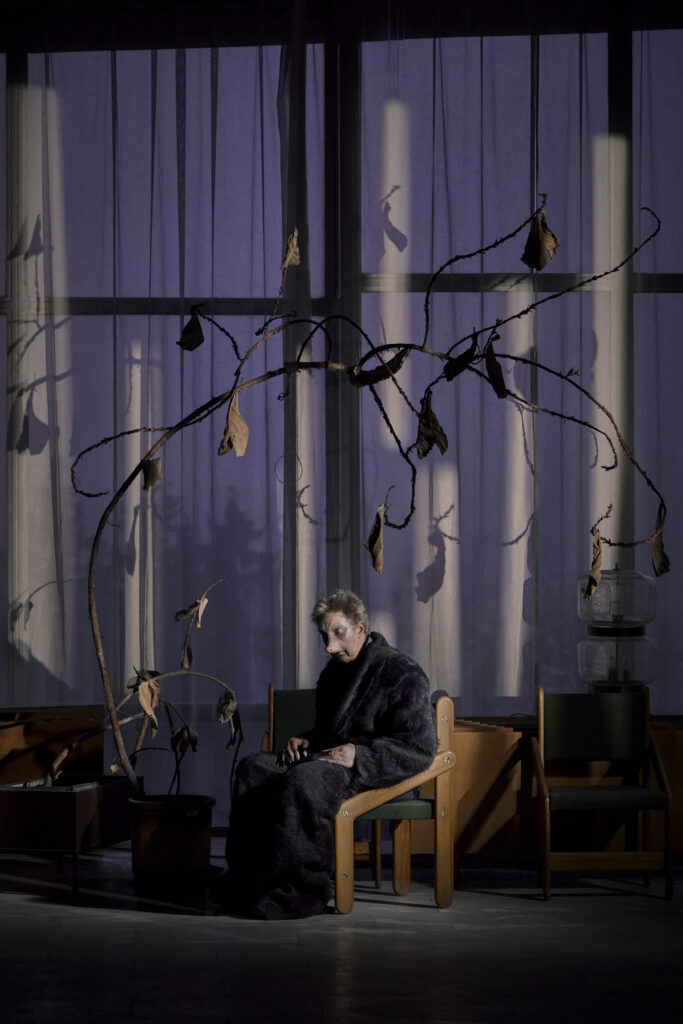
Silence does similar work. It isn’t an absence of meaning, it’s a charged form, what the curatorial text calls a “radical gesture of refusal.” The Ear of the Householder in the pavilion senses a faint, indeterminate sound and bears witness to it. That’s a very different register from stating a position. It lets the political enter through pressure and atmosphere rather than through explanation.
The trap of overstatement comes, I think, from anxiety, wanting to make sure the audience arrives at the right reading. Trusting the work to carry meaning at a slower, more oblique level requires accepting that some visitors won’t “get it” in the way you imagined. That’s fine. Some of the most political gestures are structural in how a space is occupied, what it refuses to deliver and who it addresses. Those things don’t need to be legible to be working.
In your view, is it still necessary for a pavilion to respond to current geopolitical realities—or can disengagement be a position in itself?
Disengagement is always a position. There is no neutral pavilion, choosing not to address the present is itself a statement, and in this moment, that statement tends to align quite comfortably with dominant powers.
But I also believe in the autonomy of art. Not every work needs to explicitly respond to every political situation; art’s function is much wider than that, and reducing it to commentary would be its own kind of impoverishment.
What makes disengagement untenable right now, at least for me, is that you arrive at the Biennale and the geopolitical reality is already in the room. The Russian pavilion is there. The Israeli pavilion is there. The context speaks before you do. Pretending otherwise isn’t neutrality; it’s a choice with consequences.
What matters is that the response doesn’t have to come only through the work itself. A pavilion is also a platform, with its own visibility, its public presence, its audience. That creates other possibilities: how you speak about the project, what positions you take outside the exhibition space, what you decline to stay silent about. The art can operate at the level of atmosphere and form while the platform does something more direct. The forms a response can take are much wider than the genre of the “political pavilion” suggests.
What is currently influencing your thinking outside the art world—and why does it matter to your work?
Rap is one of the forms that has shaped me most, going back to childhood. Hip-hop culture broadly – graffiti, fashion, photography, has a kind of integrative energy that I find genuinely inspiring. It’s a culture that never separated aesthetics from politics, or craft from community.
Video games are the other thing. They’ve become an integral part of contemporary culture in ways the art world is still catching up to. I think about them the way people once thought about film, as a revolutionary form that opened up entirely new ways of experiencing and processing the world. There’s a lot to draw from there for me.
And then sports, football, Thai box, and especially running. This one is harder to explain, but it matters in a very practical way. It isn’t just about maintaining the capacity to work, though it does that too. It’s that movement generates a different kind of thinking. Ideas come differently when your body is occupied. There’s a quality of attention you reach through physical exhaustion that you can’t get sitting at a desk, as if something loosens, and things connect in ways they otherwise wouldn’t.