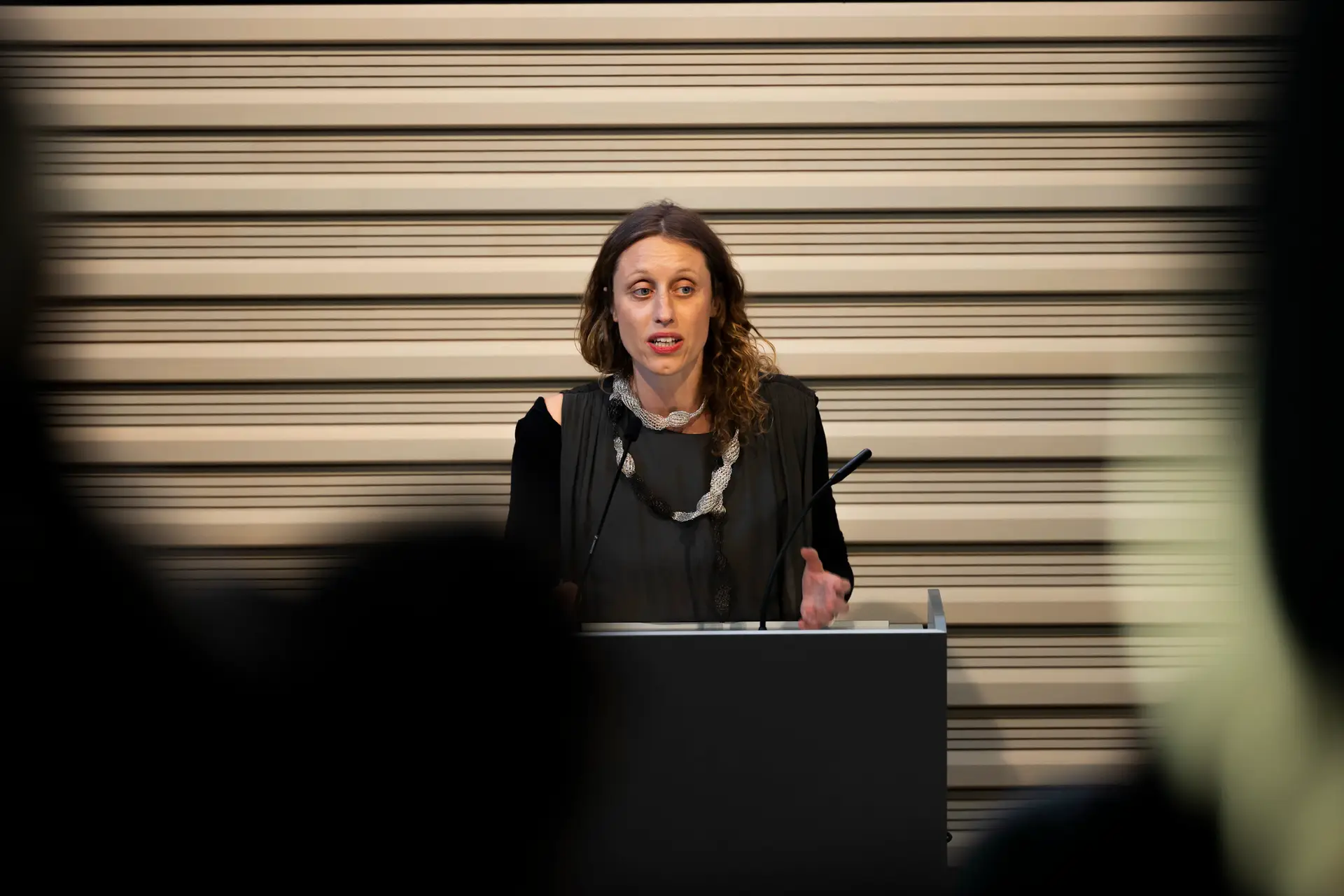
This interview took place within the framework of the Unschool of Curating, held in Timișoara and Cluj, Romania, between 19 – 26 June, 2026, organized by Art Encounters Foundation and Cluj Cultural Center. This program, now in its 8th edition, is developed collaboratively by the two organizations to strengthen curatorial networks in Romania and internationally. The Unschool of Curating focuses on informal methodologies, alternative pedagogies, and practice-led curatorial discourse. Antonia Alampi was invited this year to conduct this school in the spirit of her inspiring work as a curator, cultural organizer, and Director of Spore Initiative in Berlin.
You lived in different countries and many cities, have established and built many institutions. Presently, you act as Artistic Director of Spore Initiative, a cultural initiative dedicated to ecological regeneration, community participation, and knowledge exchange. How does this mission statement take form concretely?
For me, missions only become meaningful when they shape decisions, structures, budgets, and everyday practices. Ecological regeneration is not simply a thematic interest at Spore; it influences who we collaborate with, what forms of knowledge we prioritize, how we use our resources, and how we understand culture itself.
Concretely, this means working closely with farmers, Indigenous communities, educators, activists, gardeners, researchers, artists, and organizers whose work emerges from lived relationships with land, water, food systems, and community life. It means treating knowledge exchange as a long-term commitment to building relationships and infrastructures through which knowledge can circulate in multiple directions and especially benefit those who need it most urgently.
One question has been central to designing the work at Spore: what happens before and after a project? Too often, communities become the subjects of exhibitions, research, publications, or public conversations, while the knowledge, resources, visibility, and institutional benefits generated through those processes remain elsewhere.
Our approach starts from the premise of asking what forms of support, knowledge, infrastructure, and visibility might return to the communities most directly affected by the issues being discussed. This has led us to increasingly invest in educational materials, publications, learning tools, public resources, translations, workshops, and other forms of knowledge distribution that allow projects to continue having a life beyond an exhibition.
My experience as a parent has also shaped how I think about these questions. Parenting has made me more attentive to the many ways knowledge is shared, embodied, and transmitted beyond formal institutions. It has taught me the importance of listening, of making space for different forms of learning, and of recognizing that knowledge often emerges through care, repetition, observation, storytelling, and lived experience. These lessons have influenced how I approach cultural work: not simply as a process of producing content, but as a practice of holding space for different ways of knowing and creating the conditions for meaningful exchange.
For me, culture is not simply about producing discourse. It is also about creating the conditions through which knowledge, experience, and resources can circulate more equitably and remain useful to those who helped generate them.
How do you feel being a curator today? What do you see as your biggest challenges, what do you miss and what makes your heart beat stronger in art?
I remain deeply excited by curatorial work because it allows me to bring people, ideas, disciplines, experiences, and forms of knowledge into relation with one another. It allows me to stay with complexity rather than reduce it prematurely. It creates space for questions to remain open long enough for responsibility to emerge. It allows smaller stories to be held with the same dignity as official histories; for emotions to play a role alongside analysis; for experiences that often remain unseen to become visible and shareable. Art and culture continue to offer ways of understanding the world that are at once intellectual, emotional, and collective.
One of the greatest challenges today is acceleration. Cultural institutions are increasingly expected to produce continuously, communicate constantly, and respond immediately. This leaves less and less room for listening, trust-building, experimentation, and the long durations that meaningful collaborations often require.
At the same time, we are living through profound ecological, political, and social transformations. Curators are asked to navigate questions that extend far beyond exhibitions: questions of justice, inequality, migration, memory, land, resources, and collective futures. This is demanding, but also what makes the field intellectually and politically alive.
What I miss is time, and this is in many ways what Spore is trying to create and offer: time to stay with questions, time to build relationships, time to fail and rethink. Not because slowness is inherently virtuous, but because certain forms of trust, strategy, and collective work cannot be rushed.
Yet there is a paradox here. The urgency of the ecological, social, and political questions we engage with often pushes us in the opposite direction. We continuously find ourselves doing more, responding more, supporting more people, creating more opportunities. Providing time and space for others frequently requires operating at a pace that risks exhaustion ourselves. Navigating this tension between urgency and duration is perhaps one of the defining challenges of institutional work today.
What continues to make my heart beat stronger is encountering practices that emerge from necessity rather than positioning. Artists, communities, educators, organizers, and cultural workers who create because something meaningful and urgent is at stake, and who remind us that culture is not separate from life but one of the ways through which people make sense of the world and sustain it.
There is a tendency in artistic non-centres, such as Central Eastern Europe, to either remain specifically local or open up by emulating Western tendencies, theories, discourses, and thoughts. What are your thoughts on this and what type of institution could break this model?
I have always been suspicious of the assumption that innovation travels from a centre toward a periphery. In reality, many of the most interesting methodologies, forms of solidarity, and cultural experiments emerge precisely from places that have had to work with fewer resources and under more complex conditions.
The challenge is not choosing between localism and internationalism. The challenge is creating institutions confident enough to begin from their own conditions while remaining in dialogue with the world.
The institutions that interest me most today are those capable of acting as holders of space rather than gatekeepers or self-appointed leaders of innovation. Institutions that understand themselves as nodes within larger networks of knowledge rather than centres of authority. Institutions that contribute to conversations without needing to imitate dominant models in order to be recognized.
I also think we need to move beyond the idea that some places produce theory while others merely provide examples. Every context generates concepts, methodologies, and forms of knowledge. The question is whether institutions create the conditions for those knowledges to circulate, encounter one another, and be taken seriously on their own terms.
The theme of the Unschool is “Repair as a Method”. What has been your curatorial experience with repair and what led you to choose this theme?
Repair became interesting to me not because it suggests that everything can be fixed, but because it shifts attention toward relationships, responsibilities, and infrastructures.
In cultural work we often focus on production: the exhibition, the event, the publication, the conference. Repair asks different questions. Why is a project needed at all, and for whom? What remains after the event? What relationships continue? What forms of knowledge circulate? Who benefits from what has been produced? What responsibilities emerge from collaboration?
Many of the methodologies we have developed at Spore emerge from these questions. They involve investing in relationships and partnerships, co-designing processes, creating longer-term commitments, investing in pedagogy, publishing, translation, redistribution, and finding ways for cultural work to remain meaningful and useful for those who need it most rather than for the institution itself. The institution needs to serve a purpose that is not merely self-referential.
Repair also requires acknowledging histories of extraction, exclusion, and imbalance. It asks institutions to reflect on how they operate, whose knowledge they value, and how resources are distributed. Rather than positioning institutions as sites of authority, repair encourages them to become platforms for exchange, learning, and mutual accountability.
For me, repair is not primarily about mending what is broken. It is about learning how to contribute to existing social, cultural, and ecological worlds in ways that strengthen their capacity to continue.
Which tools in such a method can be universally imported or applied, and which ones have to be developed locally?
I believe certain principles travel well: listening, reciprocity, transparency, translation, long-term commitment, attention to power, and a willingness to learn from others.
What never travels easily are the forms these principles take.
Repair always emerges from specific histories, communities, conflicts, aspirations, and material realities. This means methodologies must be developed with people rather than imported for them.
The most transferable thing is perhaps not a toolkit but an attitude: curiosity, humility, attentiveness, and a commitment to working with what already exists. Too often institutions arrive with solutions before they have understood the conditions they are entering. Repair requires the opposite movement.
How do you plan to reflect on the Unschool itself as a form of knowledge production and what toolkit can emerging curators acquire during this programme?
The Unschool itself is an experiment in knowledge production.
Rather than treating participants as recipients of expertise, the programme assumes that everyone arrives with experiences, contradictions, questions, and forms of knowledge that matter. Peer learning therefore becomes one of the central methodologies of the week.
The programme combines contextual grounding, food practices, collective reflection, role play, Theatre of the Oppressed, ecological thinking, studio visits, institutional conversations, and peer exchange not because these are separate themes, but because curatorial work increasingly requires the ability to move between different forms of knowledge and different scales of engagement.
I hope participants leave not with a formula, but with a greater sensitivity to context, relationships, infrastructures, power, and responsibility. I hope they leave with practical tools for listening, collaborating, building trust, recognizing invisible labour, navigating institutional contradictions, and developing practices that remain meaningful over time.
Which aspects did you take into consideration when selecting the speakers?
I was less interested in selecting experts on a topic than practitioners who embody particular methodologies.
Each contributor represents a different way of working: contextual grounding, hospitality, collective learning, community organizing, ecological thinking, historical research, institutional experimentation, or practices of maintenance and stewardship.
Together they form an ecology rather than a panel of specialists.
The hope is that participants encounter not only ideas, but different ways of practicing culture. They will meet people who have developed methodologies over many years and in very different contexts, and who can speak from experience rather than abstraction.
In your opinion, what are the skills that an experienced curator should transmit to emerging colleagues in today’s artistic and curatorial ecosystem?
Perhaps the most important skill is learning how to remain attentive.
Attentive to context. To power. To people. To resources. To language. To what is present and what is absent.
Beyond that, I think curators today need to learn how to build relationships, how to work across difference, how to collaborate without erasing asymmetries, how to sustain long-term commitments, and how to recognize that cultural work is never only about exhibitions or events.
They need to understand institutions not only as places that produce programmes, but as infrastructures that distribute resources, create opportunities, circulate knowledge, and shape relationships.
The curator I admire is not necessarily the one with the strongest individual voice, but the one capable of creating conditions in which many voices, practices, and forms of knowledge can encounter one another meaningfully.
In the end, curatorial work is less about producing events than about cultivating the conditions through which knowledge, experience, and collective capacities can continue to circulate, grow, and remain useful over time.