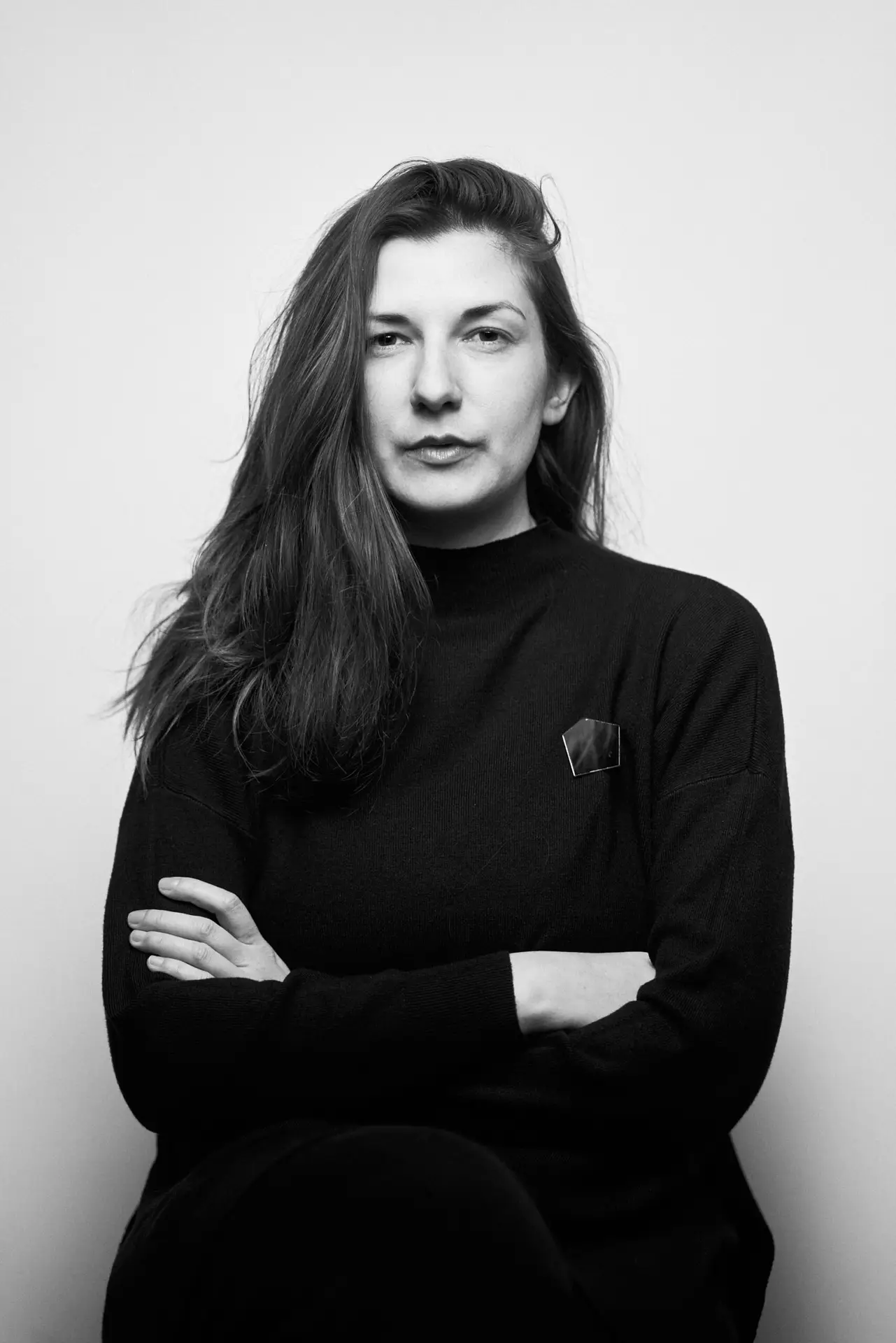
Adelina Luft sees the first-ever Moldova Pavilion at the 61st Venice Biennale not simply as a national debut, but as a political and emotional act of resistance. In conversation with us, the curator reflects on Pavel Brăila’s On the Thousand and Second Night—an installation staged inside Venice’s Santa Veneranda chapel that confronts war, territorial violence, and the collapse of collective imagination through carpets, drone propellers, and sound. Luft speaks about the limits of the “Eastern European” label, the uneven visibility of artists outside Western institutional networks, and why Moldova’s presence at the Biennale matters in the current geopolitical climate. Rather than offering a direct political illustration, the pavilion proposes what she calls “an invitation to rewrite the narrative of the future”—a fragile but urgent space where unease and hope coexist.
If you had to distill your pavilion into a single idea, what would it be—and what does it push back against?
Our pavilion proposes a strong conceptual idea, apparently simple in form but profound in its message. It is an installation that enters into a reciprocal dialogue with the space in which it is presented. The chapel of Santa Veneranda, our venue for the Moldova Pavilion, elevates the work both literally and symbolically, adding a layer of significance; in turn, the space itself is altered by the work, expanding its purpose.
On the Thousand and Second Night is an installation that builds on contrasts: the fairy tale coexists with the nightmare; the hope for harmony is present, yet interrupted by the sounds of terror and war; the unseen forces of the divine compete with the power of the wicked. It is an open invitation to rewrite an alternative narrative of the world we live in—to imagine, even if only as an exercise, a world in which wars are a distant memory.
It pushes back against the domination of territories and the erasure of human and more-than-human lives; against the control of our ability to dream and imagine alternative narratives; and against the oppression that denies the possibility of living a life in peace and dignity.
Why this artist, and why now?
Pavel and I come from very different generations, yet through the process of preparing the pavilion we realized that our synergies and ways of working align in unexpected ways. He is an artist with remarkable energy, a strong team spirit, a storyteller, and a good organiser. His artistic practice resonates with what I have been exposed to and engaged with in Indonesia, for instance, where artists are highly inventive in developing compelling concepts rooted in their day-to-day social and political realities.
Each biographical chapter matters and contributes to the formation of a body of work that gains weight precisely because it emerges from a context of constant struggle and political shifts. His practice has been shaped by contingencies, genuine curiosity, playfulness, and a certain degree of courage, taking an unusual path into the arts—through subcultures in Chișinău, as well as through sport, photography, cooking, social networks, and more. This feels very familiar to me and echoes my own path into curating, which was also unconventional, as I developed professionally in Indonesia without institutional or academic backing.
In Pavel’s practice, concepts and ideas take center stage, as they can speak for themselves without requiring rigorous or overly theoretical discourse. This approach stems both from his early encounters with Western art during a time of transition and from a deeply situated practice in Eastern Europe, where production resources may be limited, but freedom is expansive, disciplinary boundaries are fluid, and the small scene allows for quicker visibility.
Now is the right moment to present Pavel Brăila in the Moldova Pavilion. First, because Moldova should begin to represent itself officially at the Biennale, as this is a significant moment to do so within the current geopolitical context, marked by both pro- and anti-EU sentiments. Pavel is among the artists who have played a key role in educating new generations of artists in Moldova, while also achieving international visibility through works grounded in the realities of his country.
On the Thousand and Second Night is an invitation to rewrite the narrative of the future, and the current political climate urges us to take a stronger stance against war and the erasure of human lives. In this sense, the work is deeply timely: it speaks to a reality so violent and destructive that it can feel almost impossible to imagine a way out. Pavel Brăila seeks to remind us that hope still exists—and that we can create our own story of peace.
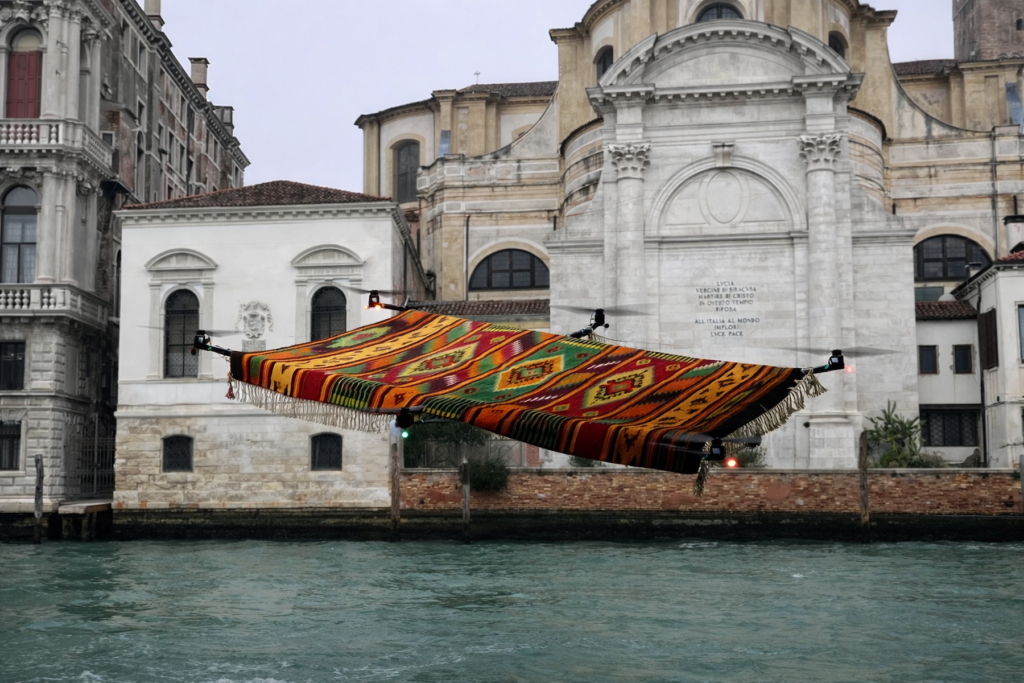
Photo credits: On the Thousand and Second Night archive
Courtesy of the On the Thousand and Second Night team
What does participation in the Venice Biennale actually change for you—beyond visibility?
Even before participating in the Venice Biennale, a major success was that our project managed to shift perspectives within the Ministry of Culture in Moldova regarding the importance of this participation, especially within the current geopolitical landscape. This representation and recognition of the Republic of Moldova at the Venice Biennale already feels like an achievement in itself; the fact that we made it here in the first place was, in many ways, unexpected.
Personally, I am very glad to be part of this opening—this step forward for the scene in Moldova—to contribute to it and to stand alongside Pavel in speaking from this position. It feels quite unique. I think that, just as important as the message we convey through the installation in the chapel, is the fact that we are able to do this under the umbrella of the Moldova Pavilion. In this sense, everything works together to reinforce and amplify a message that builds and multiplies: an installation of carpets in a church, addressing a world damaged by war, speaking from the eastern margins of Europe.
“Central and Eastern Europe” is still widely used as a category—do you find it meaningful, limiting, or outdated?
As a category, it is not particularly useful, yet it remains important to maintain a sense of positioning. It serves more as a way to indicate loose coordinates—to communicate the location from which one operates. I do need to reference it in relation to my practice, as much of my work emerges from navigating local conditions, with all their possibilities, challenges, and struggles.
Operating in a context like Romania is both exciting and discouraging at the same time. One should therefore be aware of their own positioning and how this is communicated and perceived from the outside. In my projects, I tend to use this category when referring to a group of initiatives located in this region—not to suggest a common identity, but to place them in dialogue, to compare and analyse them through a local lens. Even though our realities and contexts differ significantly, there is still a sense of operating on equal footing, especially when compared to Western counterparts. There is a shared history that continues to shape our contemporary realities, so certain commonalities persist, even as they constantly shift. At the same time, we see different urgencies emerging across Europe, which suggests that there are broader issues to address beyond the regional level.
I am also part of tranzit.org, a network of art and cultural initiatives across Central and Eastern Europe. Through this network, we connect local actions to amplify cross-border dialogue and to resist cultural fragmentation. In this sense, the category becomes a useful framework for a long-term commitment to fostering exchange within the region.
Do you feel your work is read differently in Western contexts—and if so, is that a misunderstanding, a projection, or something you actively work with?
Working with colleagues—artists and curators who began their careers during the transition (roughly 1995 to 2005), including Pavel Brăila—I’ve come to realize that the West was not always able to fully understand local artistic production; and it still isn’t. Instead, it often selected what seemed legible or interesting for its own audiences. At that time, artists were also responding to this need for representation and made explicit references to national or regional identity in their work.
I’m not sure how this was ultimately received in the West, or what kind of imagination it has produced over time about the “East,” but things are somewhat different now. In my case, however, I sometimes feel that my work is not only misread, but simply not seen—largely because I do not operate within Western institutional or academic networks. I have developed my curatorial practice in Indonesia, where the relationship to the West is fundamentally different, while in Romania these dynamics come with other kinds of ties and dependencies.
At times, it can be frustrating to work with limited budgets, alternative spaces, and a general lack of time and attention—conditions that are often less pressing in Western contexts. So, while we are actively producing work locally in Eastern Europe, it tends to be seen and appreciated mainly within the small network we have built over time through consistent effort, rather than across broader levels of the art world.
In my practice—especially when working with initiatives connected to land, communities, and shared resources—there is often a deeper mutual understanding of how we operate and care for local ecosystems. This contrasts with exhibiting in more institutional settings, which may have limited experience engaging with practices developed outside formal structures or under more precarious conditions. Among international peers, we often observe a degree of ignorance—sometimes intentional, sometimes not—toward work emerging from this context, particularly when it comes to inclusion in broader conversations around decoloniality, commoning, or even in major curatorial frameworks (for instance, artists from Eastern Europe are still rarely included in the central curatorial narrative of the Venice Biennale).
I am curious how this work in the Pavilion will be read by audiences everywhere, not just Western ones. At the same time, what matters more to me is its capacity to resonate on a human level. The hope is that it can raise awareness more broadly—not only among the art public, but beyond it.
At what point in the process did you become most aware of your geopolitical position—and did it open doors or quietly close them?
For us, this awareness became most evident in the transition from initially wishing to represent the Romania Pavilion to realizing the possibility of establishing the Moldova Pavilion officially for the first time, with the involvement of the Ministries of Culture and Foreign Affairs. This shift needs to be understood within a broader geopolitical landscape that is impossible to ignore: the war in Ukraine, Moldova’s urgency to secure EU support, the mandates of the current presidents in Moldova and Romania that have enabled the financing of such participation, and the cultural shifts taking place locally in Moldova as part of its EU accession process.
In this context, Moldova’s decision to invest in the arts and in its international representation—particularly at the Venice Biennale—is a courageous move. What we bring forward is not only this novelty, but also a proper representation of the Pavilion: a secured space, with support from both public and private funders to be able to realize a project that is not under constant pressure, precarity or disillusionment.
What was the hardest decision you made that no one visiting the exhibition will ever notice?
In our pavilion, decisions were made collectively—primarily between Pavel, myself, and Andrei Sclifos, the producer of the installation, but also with the wider team. Even though I always strive to work collaboratively and acknowledge each person’s input, it was challenging for me to let go of my tendency to control every aspect and to trust the technical team to develop the best solutions for specific tasks.
Perhaps the most difficult—and ultimately most important—decision was precisely this: to build and rely on mutual trust. Many of the decisions were made together in such an intertwined way that, from the outside, it is impossible to trace who contributed what, or to distinguish whose ideas or small gestures belong to whom—which, of course, is not visible.
How do you negotiate the line between aesthetics and politics without falling into illustration or overstatement?
In On the Thousand and Second Night, Pavel Brăila departs from a very sincere feeling—that, as an artist, he cannot move past the war, particularly as it was experienced in 2022 in Moldova, when the war in Ukraine began. Much of his recent work engages with the amplitudes of war—not only at Europe’s margins, but elsewhere as well—and with how this terror circulates through mass media and its imagery. War was once perceived as something happening elsewhere, but now it feels closer than one might have imagined.
Whether war needs to be directly framed in relation to politics is another question—one that is part of the problem, but not explicitly addressed here. At the same time, the installation is not overtly aesthetic, as it is less concerned with rigorous visual composition than with how different elements come together to form the work. The carpets—selected through a network of peers and family—take center stage, yet they stand on equal footing with the drone propellers and the sounds they produce, alongside the space that amplifies and opens it.
What the work seeks is to generate a simultaneous sense of unease and hope. These may seem like broad or general terms, but they reflect the urgency of the times we are living in. The world feels deeply unsettled, marked by loss and the devastation of human life. Sometimes, the only possible gesture is to state this plainly—that it must end. As such, we aim to produce an emotional response in the viewer. If that happens, it is already an accomplishment.
In your view, is it still necessary for a pavilion to respond to current geopolitical realities—or can disengagement be a position in itself?
More than directly responding to geopolitical realities, a pavilion should strive to be relevant to the context it comes from—social, political, and cultural—while also pushing beyond these limits toward new ways of relating to and connecting with the world. In this sense, it becomes a form of translation.
Relevance also lies in the urgencies a project addresses and in how it contributes to a broader dialogue within the context of the Venice Biennale, where connections between regions and geographies are shaped through artistic propositions. Given that the Biennale format is inherently geopolitical, it cannot pretend that individual pavilions exist outside this framework.
In this way, pavilions can assume greater accountability for what they represent. When a country is implicated in acts of war or violence, the situation becomes inherently political; therefore, decisions to step out of this form of representation should be indisputable.
What kind of reading—or misreading—of your exhibition would concern you the most?
I expect multiple interpretations of the installation, given its conceptual and sensorial nature. Within the context of the Biennale and the type of artistic production it implies and supports, the work may be misread if approached from a singular perspective. Some viewers, due to sensitivities around belonging and material culture, might find it unsettling that a carpet from “their” region is integrated into the installation while the artist does not originate from that geography. This kind of possessiveness over cultural patrimony and symbolism may shape the reception of the work, even though the carpets themselves stand as direct evidence that their cosmologies and symbolic systems are interconnected. This is precisely what the work seeks to emphasize: the need to move toward a new paradigm that renounces borders and cultural possessiveness in favor of a culture of appreciation and interconnectedness.
What is currently influencing your thinking outside the art world—and why does it matter to your work?
I see art and life as inextricably related; therefore, everything I do is connected to my role as a curator, understood more closely in its original sense of “taking care” of my community and of my relationships with different artists and exhibitions I work on. The work I do with tranzit.ro/Bucharest, as well as with the larger community on shared land outside Bucharest, is part of my day-to-day practice and my day-to-day life.
What influences my thinking is not so much theoretical right now, but very practical. I am focused on the possibilities of building infrastructure within this community, which I am developing together with my colleagues. This also includes finding funding to support the project, which is very different from making an exhibition or working within a conventional cultural project framework.