At the 61st Venice Biennale, the Polish Pavilion’s Liquid Tongues explores alternative forms of communication, collective listening, and coexistence across human and more-than-human worlds. In conversation with curators Ewa Chomicka and Jolanta Woszczenko, we discussed Deaf culture, underwater communication, geopolitical realities, and the political potential of attentiveness itself. Moving between activism and poetic immersion, the pavilion challenges dominant linguistic and social hierarchies while imagining new forms of community in a world marked by crisis, exclusion, and fragmentation.
If you had to distill your pavilion into a single idea, what would it be—and what does it push back against?
Our project explores alternative ways of communicating, building, and rebuilding communities, inspired by more-than-human life. It seeks to imagine a future in which all voices are not only noticed but truly heard, including non-human ones. It challenges hierarchies and cultural and linguistic exclusions created by dominant groups and calls for the recognition and agency of less privileged voices.
Why this artist, and why now?
Each of us has previously collaborated with Bogna Burska and Daniel Kotowski on various projects. Last year, Ewa worked with Bogna and Daniel on the performance Rebellion of the Deaf. Renewal, which brought together hearing and Deaf participants in an experimental choral practice, exploring the possibility of building inclusive, agentive communities. Meanwhile, Jola curated the exhibition Breathe, in which Bogna and Daniel investigated underwater modes of communication. Both of these projects serve as direct inspirations for Liquid Tongues, which brings together and further develops these explored threads.
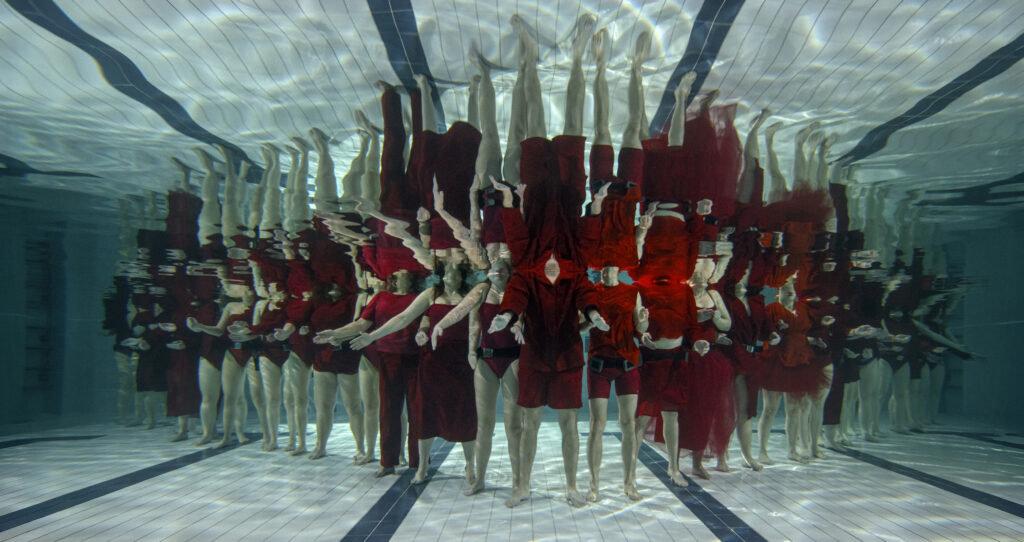
In Liquid Tongues, the boundary between air and water becomes a space for communicative experimentation. Underwater, roles are reversed – Deaf individuals communicate naturally, while hearing individuals produce distorted, unintelligible sounds. This reversal reveals the concept of Deaf Gain, positioning deafness not as a disability but as a distinct identity and culture that offers unique perspectives and potentials. By inverting familiar communicative hierarchies, the project invites a critical discussion of entrenched linguistic and cultural dominance.
Why now? We believe there is an urgent need for alternative scenarios of communication in a contemporary world marked by division, conflict, and violence – both between people and stemming from anthropocentric forms of species domination. We need heterotopias that distort dominant patterns and shift the focus from division toward building, toward mutual listening – including the strengthening of collaborative forms between humans and other species within a shared, damaged environment. The project shows, that despite differences, we are in a collective struggle for “breath”.
The theme of Liquid Tongues strongly resonates with Koyo Kouoh’s curatorial concept for the 2026 Biennale and her musical metaphor of a “minor key,” which invites a contemplative encounter with the subtle and often overlooked – quieter voices, suppressed narratives, and micro-memories. Fitting into these curatorial “frameworks” was not our intention – they simply converged. We believe this is a sign of how much we need to join forces in search of new, better possible forms of coexistence.
What does participation in the Venice Biennale actually change for you—beyond visibility?
Participation in the Venice Biennale reinforces our belief that explorations of possible ways of understanding and developing communities, which emerge in grassroots or less visible spaces, can be made visible – and thereby strengthened. This is not merely a theoretical construct on our part – the project is co-created by an artistic duo consisting of a hearing artist and a Deaf artist, and the performers come from the Choir in Motion community, a socially rooted choir open to experimentation and exploration. Ewa, the co-curator of the exhibition, is also a member of the choir. The group is composed of both hearing and Deaf participants, challenging the traditional understanding of a choir as solely voice-based – within the project, both spoken and signed languages function as fully legitimate languages of collective expression.
The project was developed through trials, testing, and experimentation, yet in a safe way, with mutual attentiveness to each participant’s needs, abilities, and limitations.
Because of the processual and social nature of working on this project, these themes are not only the message of the work but also our embodied knowledge. This is the biggest “change”, these are the most valuable lessons that participation in the Biennale offers us. Without the Biennale, we could not be certain that this complex social process – along with experiments between air and water – would ever come to fruition, given its scale and challenges.
“Central and Eastern Europe” is still widely used as a category—do you find it meaningful, limiting, or outdated?
This is a very complex question, so we will focus mainly on the categories related to the linguistic meanings of the term, which also shape how it functions. In the Western world, the term “Central Europe” is still rarely noticed. It is no longer as dominant as it was ten years ago, when, as a Polish person, we often had to explain that Poland on the map belongs to Central Europe, not Eastern Europe. Today, we notice that the term “Central” is increasingly used, probably due to greater knowledge about our countries and more frequent travel to them. In our view, we have never considered the distinction between Central and Eastern Europe as limiting; rather, it serves as a tool for others to situate themselves on the geopolitical map of the continent. With the changes within Europe itself, we now perceive it as a shared space — we are different, and we should embrace our national or linguistic distinctiveness, but we must not forget that we emerge from the same cultural and historical framework. From the perspective of, for example, Asia, we are all Europeans.
Do you feel your work is read differently in Western contexts—and if so, is that a misunderstanding, a projection, or something you actively work with?
The project carries a very universal message. It evokes stories of loss, but also of cultural recovery, as well as contemporary efforts to reclaim languages marginalized by dominant narratives. These are stories from around the world, that also strongly incorporate the perspectives and experiences of Deaf people. Importantly, the project reaches beyond human histories to include animals as well – whale communication serves as its inspiration.
For years, water – oceans and seas – was imagined as a silent space, and only through hydrophones and recordings have we discovered the rich, complex world of underwater communication. This history shows us that there is a real possibility for change in empowering marginalized narratives by making them visible. We also want to emphasize that the systems oppressing disabled people and non-human animals – ableism and speciesism – are interconnected, as Sunara Taylor, the author of the concept of “disabled ecologies”, points out. This highlights the need to seek shared forms of liberation.
At what point in the process did you become most aware of your geopolitical position—and did it open doors or quietly close them?
As we mentioned, the project carries a highly universal message, bringing together themes of building more inclusive human and more-than-human communities. Along the way, however, we were asked to what extent it relates to the war in Ukraine – our neighbor, which has been suffering for several years from the horrors of ongoing conflict. The previous project representing Poland at the Biennale addressed this issue directly. Positioning Poland in immediate proximity to a country at war has clear consequences – both for our sense of security and for the widespread social opposition to the violence we are witnessing, as well as solidarity with a nation unjustly affected by the brutality of war. Nevertheless, we are living in a time of polycrisis in a wider sense – successive wars continue to unfold, while the experience of the pandemic and the climate crisis generate a pervasive sense of instability. Culture and art are increasingly described as forms of shelter – spaces of refuge, encounter, and the building or recovery of meaningful, safe relationships. Perhaps our need to search for ways of constructing real communities and alternatives to the contemporary world is more deeply rooted in this context than we are fully able to recognize.
Is there such a thing as a shared “Central and Eastern European-ness” in contemporary art, or is that idea mostly imposed from the outside?
A shared perspective on art in Central and Eastern Europe was largely imposed by the geopolitical order after World War II, which incorporated these countries into the communist bloc under Soviet dominance. Within this context, a turn toward conceptual and post-conceptual art became prominent, serving as the primary mode of artistic expression across the Eastern Bloc from the 1960s onward. These historical experiences, along with the particular forms of creative expression developed under pervasive censorship, shaped a distinctive understanding of art in the region. Today, nearly 40 years after the fall of the Berlin Wall, research reveals the differences between individual countries and their artistic practices. Yet despite these variations, contemporary art continues to draw on the past experiences that shaped it.
What was the hardest decision you made that no one visiting the exhibition will ever notice?
Liquid Tongues is a highly complex project, as is the process that led to its creation. Along the way, we encountered many difficult decisions and unexpected situations. We developed a project involving dozens of artists and participants, which won the competition to represent Poland as a concept – yet the entire work still had to be refined and produced within just a few months. The “difficult decisions” we faced – ranging from the internal dynamics of teamwork, questions of representation and the visibility of different voices, and the selection of film material during editing, to architectural and technological choices (all, of course, within specific budgetary constraints) – may be evaluated differently by different people. We worked collectively, making key decisions within a four-person curatorial-artistic team, within a hearing–Deaf team, and in collaboration with dozens of contributors, each bringing diverse needs and perspectives. The time pressure we faced naturally did not make this process any easier. All the more, we appreciate it and are proud that, despite these demanding conditions, we were able to care for the collective process, conduct thorough research, and maintain strong artistic quality.
How do you negotiate the line between aesthetics and politics without falling into illustration or overstatement?
Negotiating the line between aesthetics and politics in our project involved a careful balance. As an audiovisual installation, Liquid Tongues invites the audience into a multilayered immersion. The libretto is composed of metaphorical narratives, employing a poetic language – interconnected and interwoven. The installation operates through multiple elements: images captured both above and below water, the flowing choreography of individual and collective bodies across the screens, as well as music and sonic experimentation. This constitutes the sensory, experiential layer of the installation.
Its message is both subtle and expressive, carrying an activist dimension. Liquid Tongues is about songs, about singing (including signed singing), but they form a subtle voice of resistance – an assertion of presence that also calls for an active stance from us, the audience: listening and attentiveness. As the example of whales – saved thanks to their “heard” songs – demonstrates, listening can lead to change. And this is not about the normative ability to hear, but about a transformative capacity rooted in openness to other voices, in attunement, and in the act of truly hearing them.
In your view, is it still necessary for a pavilion to respond to current geopolitical realities—or can disengagement be a position in itself?
We consider responding to the present moment and current geopolitical realities to be very important, though it does not have to take a literal form – as is the case with our project. A message can be both metaphorical and carry a strong political charge. There are also many other ways of responding beyond the exhibition itself, as demonstrated, for instance, by protests signed by national pavilions or by individual artists and curators against the presence at the Biennale of countries engaged in wars and responsible for the suffering and deaths. In light of this year’s Biennale theme – supporting marginalized voices and excluded narratives – the presence of such countries is a profound contradiction and should be strongly protested, a stance we also join.
What kind of reading—or misreading—of your exhibition would concern you the most?
We are not afraid of misreadings of the exhibition – we perceive the installation as a shared space that invites resonance, activation, and the co-creation of meanings. Liquid Tongues is constantly “in-between”, moving across different languages that are inherently fluid. In our project, we understand the concept of “translation” not only as the transfer of meaning between languages or perspectives, but above all as a creative, interpretative, and critical practice. We approach it as a performative act – a tool of imagination that allows us to question our existing, including anthropocentric, viewpoints and invites a shift in the ways we think.
What is currently influencing your thinking outside the art world—and why does it matter to your work?
For me – Ewa – everyday life and reality strongly influence the topics I engage with in my curatorial practice, so I cannot draw a clear boundary here. In recent years, a particularly intense experience has been observing how the policies of other countries affect us – even when we are geographically distant – and how they can divide and crush even faraway communities. On a daily basis, I work at the intersection of history and contemporary art, with an activist twist. I analyze the narratives being created, acts of appropriation, capture, domination, and exclusion of worlds. As a cultural anthropologist – a background important to me beyond contemporary art curating – I examine these zones of collision and encounter. At the same time, both professionally and personally, I try to support weaker and marginalized voices. As you can see, this resonates strongly with the themes of our project – and indeed, I usually develop artistic projects that, from my perspective, touch on some of the most pressing and often uncomfortable questions of our time, and that also directly move me as a human being.
For me – Jola – outside the art world, several threads interest me, one of which is the recognition of plant rights and a perspective on more-than-human life that extends even beyond what we explore in our project. This shapes my practice in a broader sense, encouraging me to think about communication – not only in speaking, but also in listening, searching, and forming relationships. The world is our shared home, and it is becoming increasingly important to cultivate new connections between the natural world and the Anthropocene – not only for practical reasons, such as addressing pollution and climate change. I shift perspective and pose hypothetical questions on behalf of plants: what are we, humans, to the natural world, and, if possible, how can we establish a meaningful form of communication with it?