Artist: Rafał Zajko
Title: Organ
Venue: Coulisse Gallery, Stockholm
Photos: Coulisse Gallery
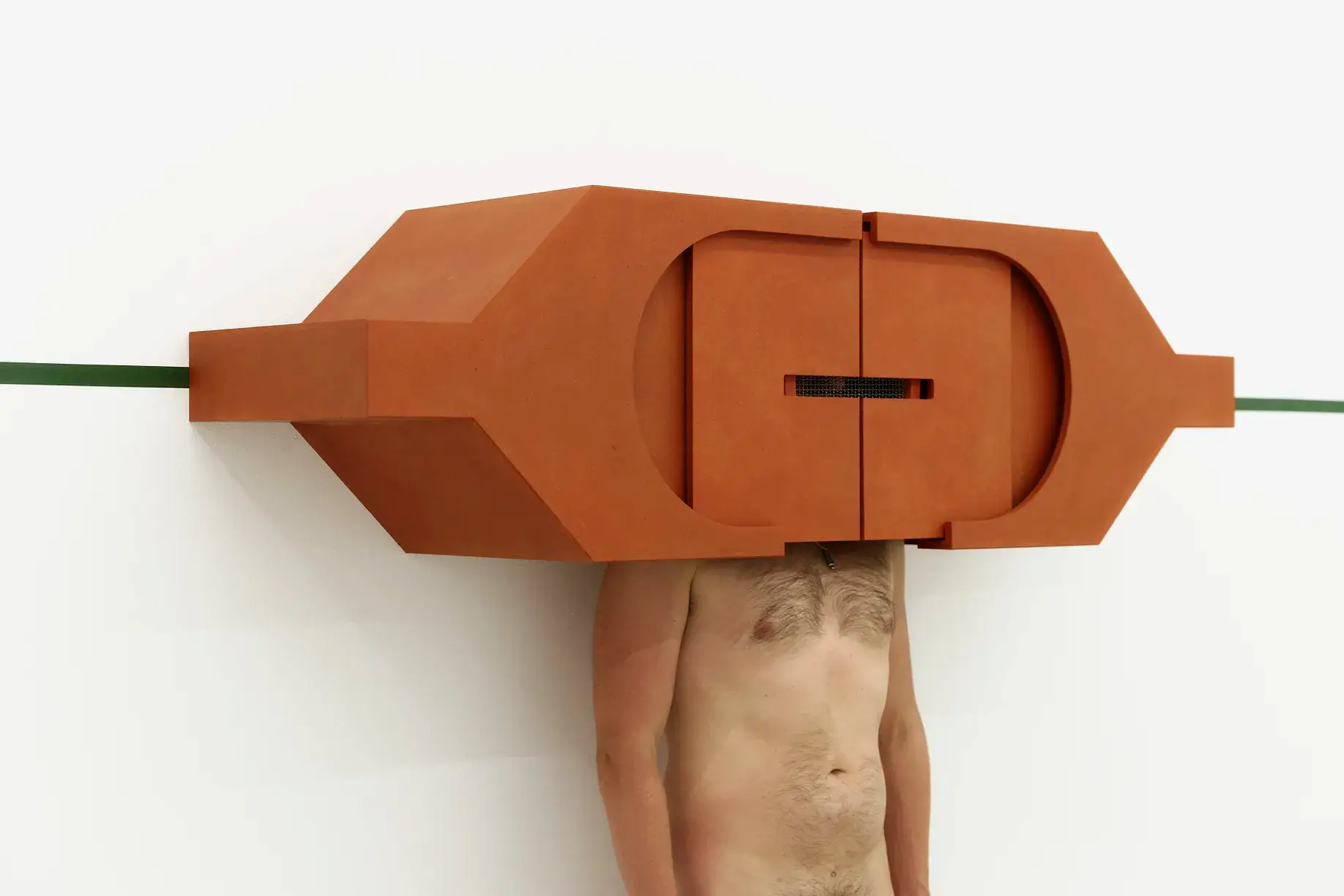
If I open my iPhone and flick to social media, I can immediately see torsos, sometimes without heads – all different people, none of whom I could necessarily identify in the meat space. Some are lithe and lean; others are firm and processed, the consequence of hours in the gym. The naked body is everywhere, and it’s less concealed and private than it has ever been before. In Rafal Zajko’s solo exhibition ‘Organ’, he employs nude men to interact with a performance sculpture that becomes a mask when it is activated, leaving their bodies vulnerable to scrutiny but their faces concealed. Amber Chamberette (2026) is affixed to the wall, like a cabinet or cupboard, with two small doors that, when pushed aside, reveal a net within a circular frame on a hinge. The performers reside inside the chamber, naked to the audience from the neck down, but alone with themselves and their thoughts.
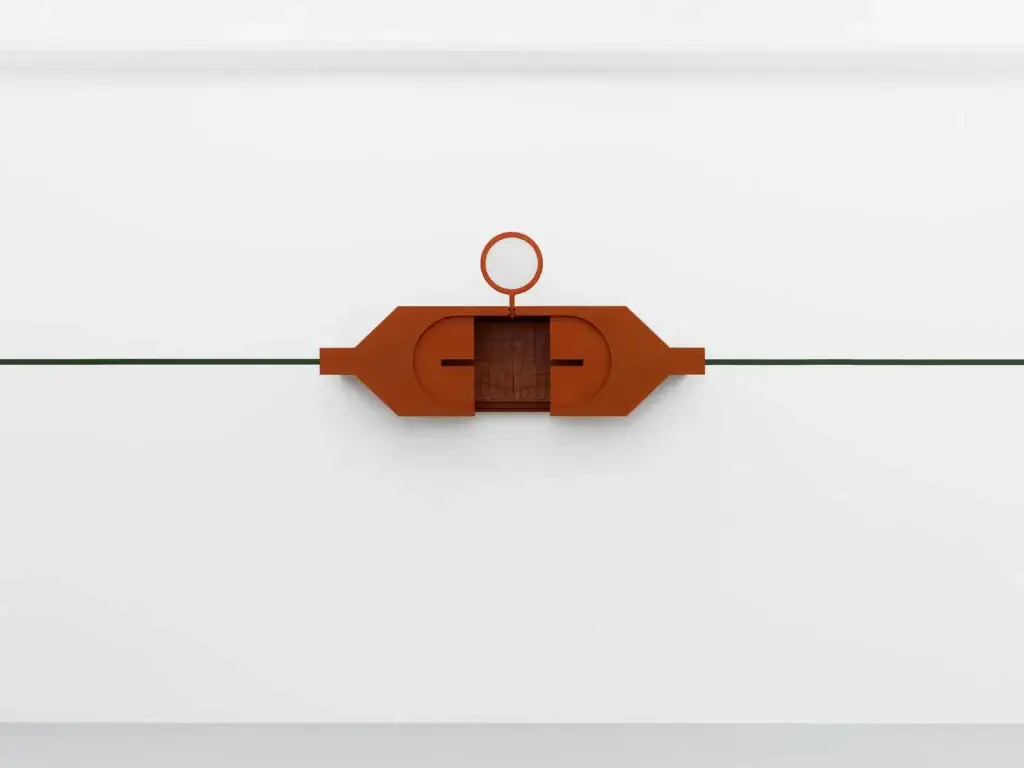
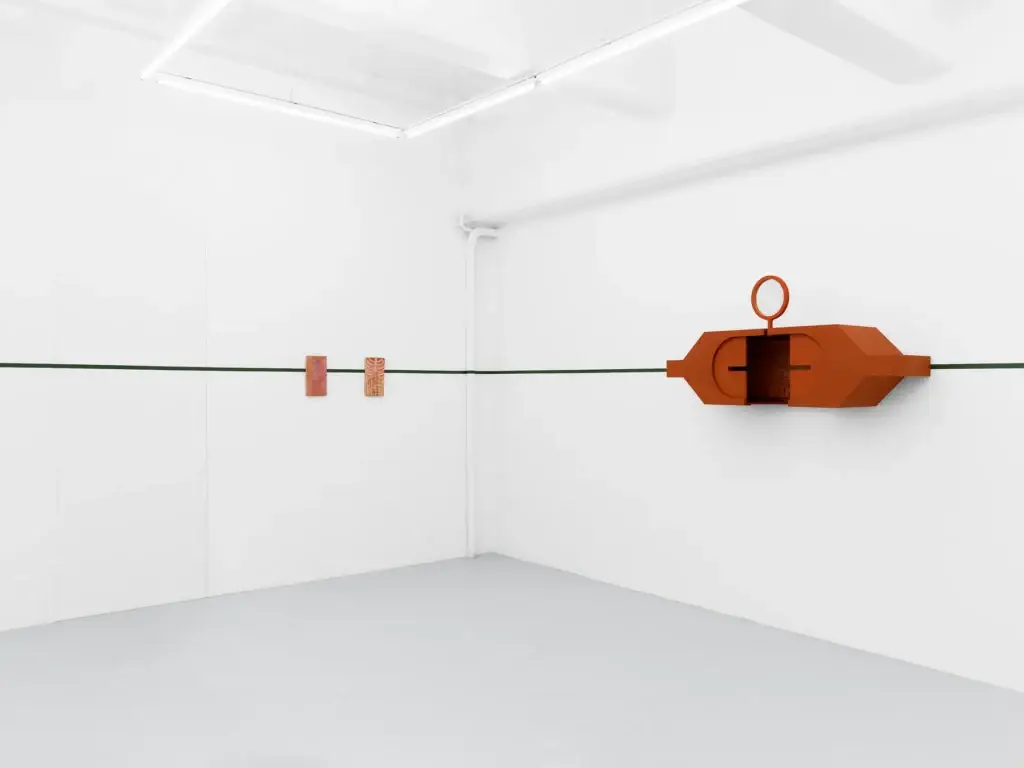
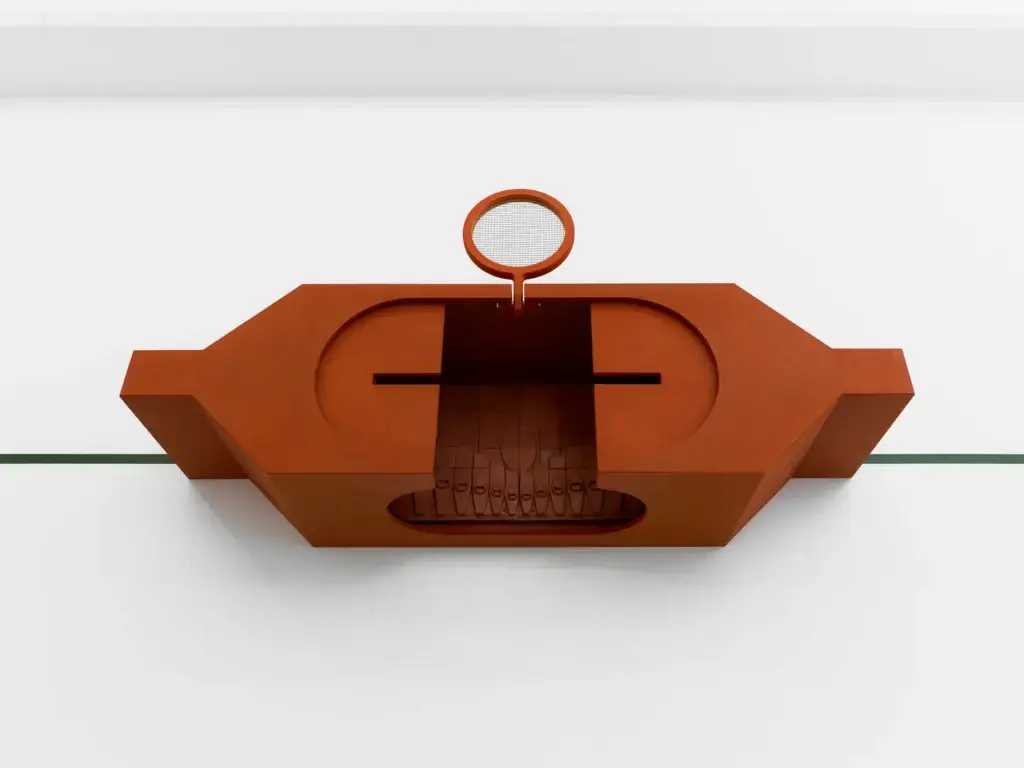
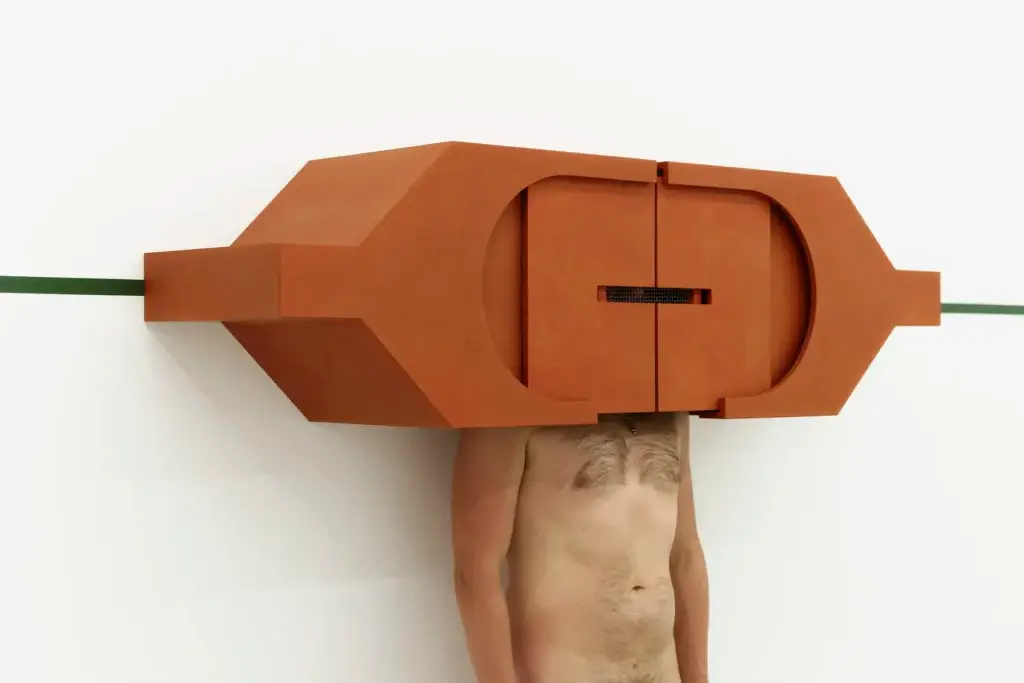
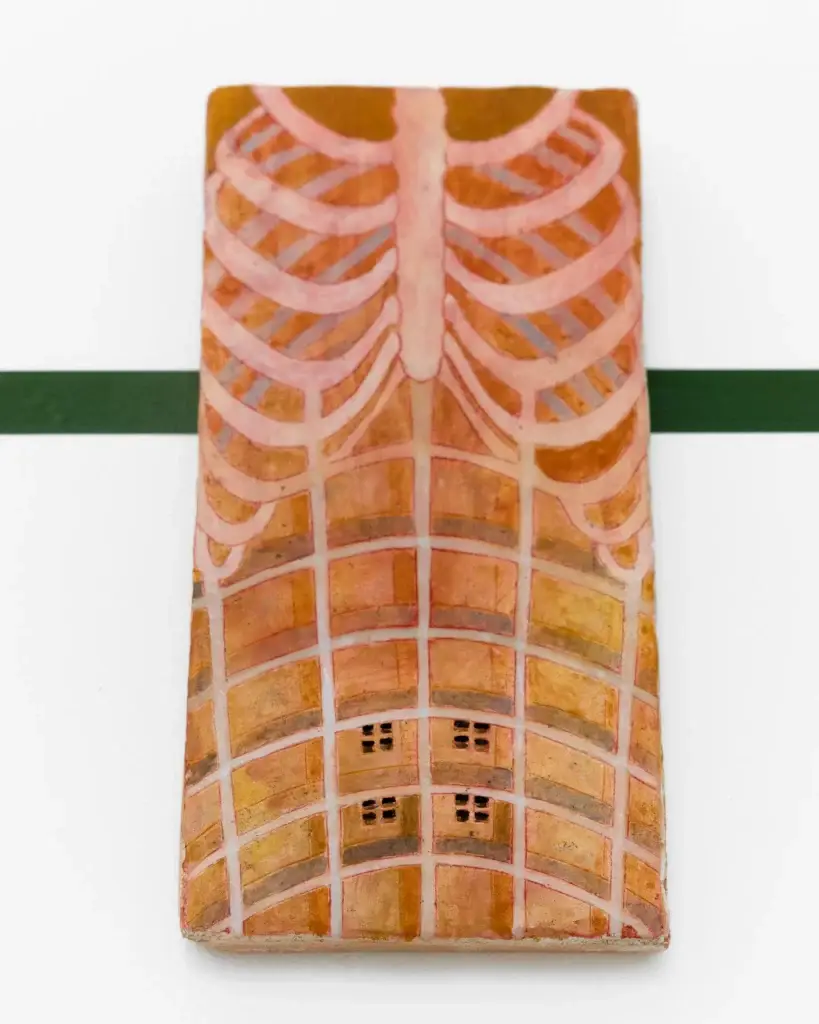
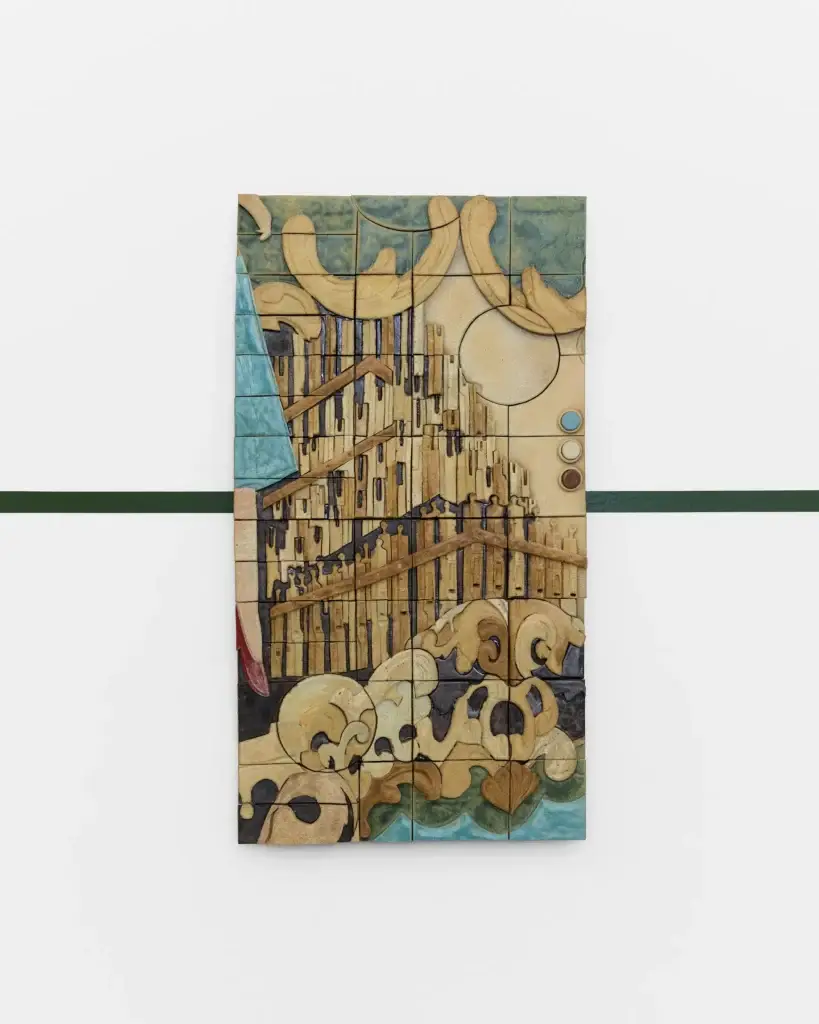
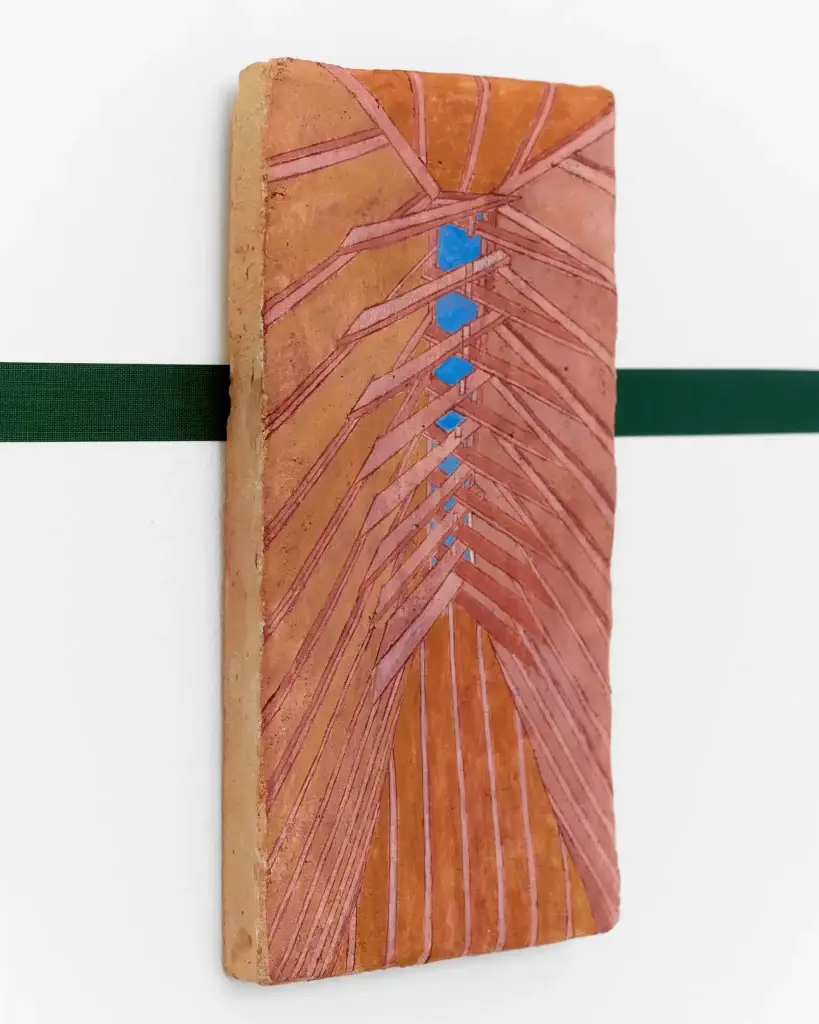
The precision with which Zajko has designed and constructed this object from fire-retardant MDF with an interior ceramic relief suggests an institutional or ritual function, or even both. Here, the performance emerges as something the object appears to demand: it is made to be inhabited in this way. But there is an absurdity to standing with no clothes on, with your back to the wall and your head in a box, albeit a carefully designed one with a net that descends to cover the face. Imagine yourself in the mind of the performer, who paradoxically appears to bear themselves to the audience but keeps their distinguishing features out of sight. The work theatricalises Zajko’s interest in how architecture is shaped by the body and how the built environment controls and orders the body. In the fresco on terracotta tile work Firmament I (2026), the two become fused: the grid structure of a ceiling appears to grow from the bones of a ribcage, a bare torso stripped of its tissue. It is displayed beside another fresco, Firmament II (2026), with the same rectangular proportions, but depicting the wooden lattice structure of a vaulted ceiling. There is no collagen or calcium depicted here, but the inference is clear: buildings are organs and bodies with interior systems and logics.
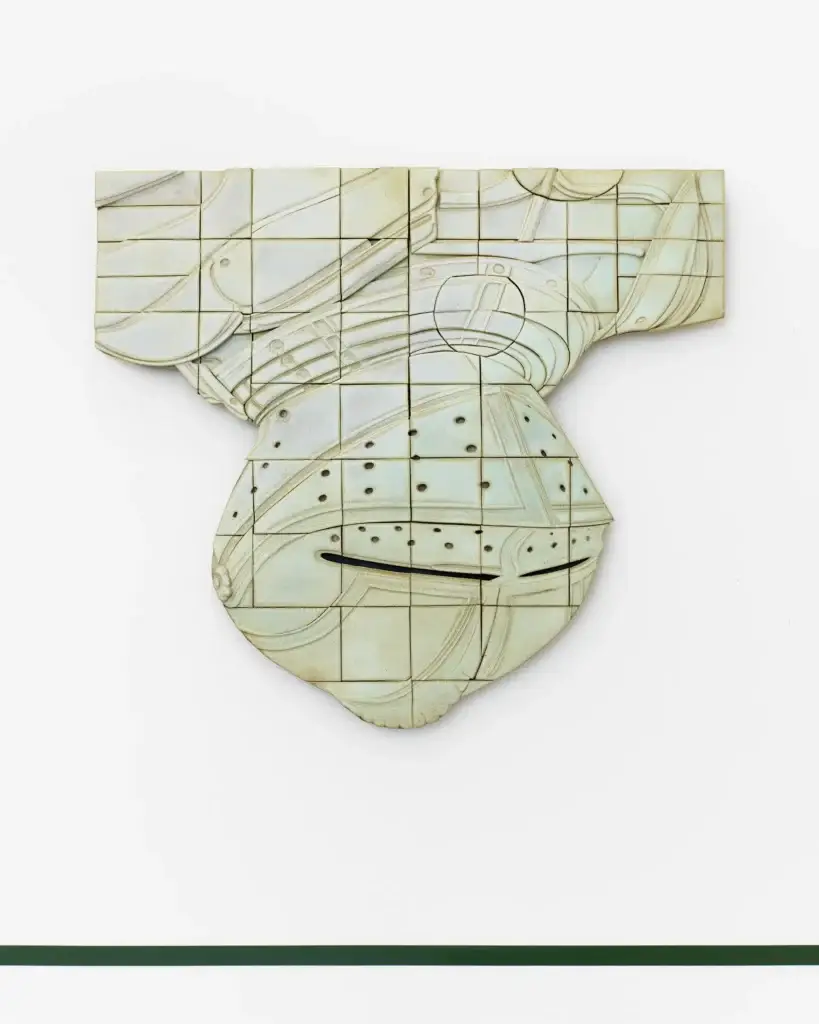
It’s a line of enquiry that recalls early 20th-century surrealism. I’m reminded of Salvador Dalí’s Burning Giraffe (1937), an oil painting in which the central protagonist has a chest of small drawers running the length of her leg, or the Ribcage Dress (1938), which the artist designed with couturière Elsa Schiaparelli, a garment that incorporates motifs from the skeletal structure into its construction. But Zajko’s approach to surrealism – and that is what it is – is less ostentatious. There is something deadpan and systematic about his installations and performances, as though the participants are workers in a factory carrying out compulsory actions on or with complicit – dictatorial, even – objects that seem to confine rather than liberate. This sense of absurdity and inversion manifests in a more subtle way in Gift (Armour)(2026), a stoneware ceramic relief consisting of 55 tiles depicting the helmet from a suit of armour that was gifted to King John III of Sweden by his sister-in-law, Anna Jagiellon, Queen of Poland and Grand Duchess of Lithuania, in 1574. Zajko flips the helmet of this ridiculous ensemble upside down, seemingly undermining its phallic and ceremonial authority while keeping its original motif legible. If the helmet was intended to protect the head of its wearer, then so, too, does Amber Chamberette shelter the head of its wearer; only the circumstances in which one would need a helmet or an MDF box are inherently compromising.
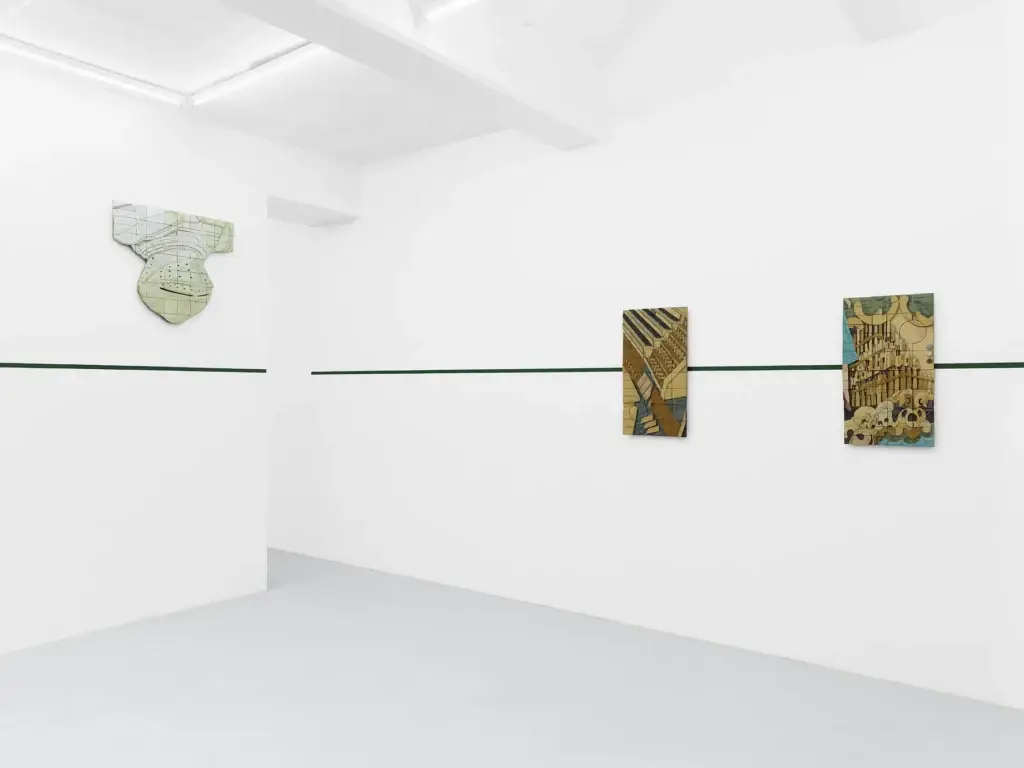
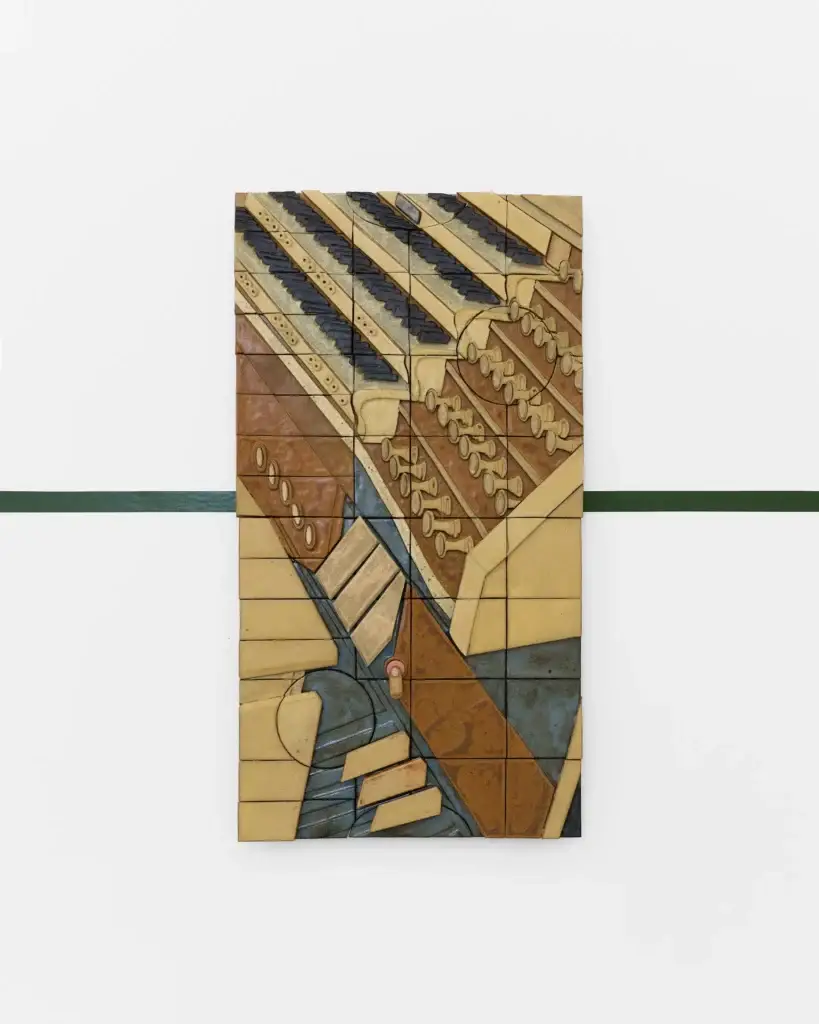
All the works here reside on a green line that runs around the entire perimeter of the room, a bearing that resembles a spirit level and suggests that, though all these objects derive from different sources, the visitor should consider them in the same register. It is positioned at the eye height of the performer in Amber Chamberette, becoming what Zajko tells me is an ‘optic nerve’ redolent of the geometry present in the work of the Polish neo-avant-garde artist Edward Krasiński. The exhibition’s title ‘Organ’ comes most clearly into focus in Kosmos XIII (2026), another ceramic relief, this time depicting the intricate workings of a street organ from Austria, its surface produced from Zajko’s staggering mastery of his material. The valves, tubes and pumps, finely crafted from stoneware clay, then glazed and fired, are here presented close up, a gesture that obfuscates the source material and replicates something resembling a biological cross-section or sample.
Zajko’s commitment to treating the gallery as an arena for theatrics that seem to concentrate the very ordinary and externalise a mental state of isolation recalls a history of artists who interacted with the studio or the gallery in a similarly existential way. Bruce Nauman forced visitors into tight, claustrophobic corridors in works such as Performance Corridor (1969), while Rebecca Horn developed elaborate, wearable appendages that seemed to map the space in works such as Finger Gloves (1972) and Pencil Mask (1972), both engendering a sense of individual alienation. However, Zajko seems set on connecting his works more concretely with their location through cultural and historical references (a specific armour or musical instrument) in a way that feels more overtly porous and playful.
It’s easy to get snagged on nudity as a shorthand for sexuality, and there is undoubtedly a fetishistic inclination about making the actions of the body procedural, but I read ‘Organ’ as relating more to notions of containment and control than libidinal expression. Zajko’s work speaks of someone with a roving eye who synthesises the psychological intensity of conceptual artists like Nauman and Horn with surrealist flourishes and source material plucked from his visual world and upbringing in industrial, communist Poland. Here, the uniform is that there isn’t one.
Sean Burns is an editor and writer based in London.